Mobile Recharge API Integration: Best Practices for 2026
A solid mobile recharge API integration balances speed, margin control, and clear failure handling. Start from the canonical mobile recharge API offering and design your retailer UX around real field conditions.
Operator and circle coverage
Validate MNP scenarios and show accurate plans to avoid customer disputes.
Retries and idempotency
Network timeouts should not double-charge wallets; use server-side idempotency keys.
Bundling
Retailers often sell recharge + BBPS + cash-out via AEPS — design navigation accordingly.
Related: Best payout API · BBPS API · AEPS API · Mobile recharge API · Request demo
Mobile Recharge API Integration: Best Practices for 2026
Integrating a Mobile Recharge API seems straightforward, but doing it right requires careful attention to performance, reliability, and user experience. Here are the best practices that top fintech platforms follow when integrating recharge APIs.
1. Choose an API with Auto-Retry on Failure
Recharge transactions can fail due to operator downtime or network issues. Choose an API provider that automatically retries failed transactions before returning an error to the user. NxtBanking’s Recharge API retries through multiple operator routes, ensuring maximum success rates.
2. Implement Proper Status Polling
Never assume a recharge transaction is complete just because you got an HTTP 200 response. Always implement status polling or use webhooks to confirm the actual recharge delivery status from the operator.
3. Show Real-Time Operator Plans
Integrate the Operator Plan Fetch API to display current recharge plans before the user selects an amount. This reduces failed transactions and improves user satisfaction significantly.
4. Handle Duplicate Transactions
Always generate a unique reference ID for each recharge request. Pass this ID in every API call so that if a network timeout occurs, the server can identify and prevent a duplicate recharge from being processed.
5. Display Proper Error Messages
Map API error codes to user-friendly messages. Never show raw API error messages to end users. Common errors include: Invalid mobile number, operator not supported, amount not matching any plan, and insufficient wallet balance.
6. Maintain Transaction Logs
Log every API request and response with timestamps and reference IDs. This is essential for customer support, dispute resolution, and regulatory compliance.
7. Test All Operators in Sandbox
Before going live, test recharges for all major operators: Airtel, Jio, Vi (Vodafone Idea), BSNL, and DTH providers like Tata Sky, Dish TV, and Airtel Digital. Catching operator-specific bugs in sandbox saves production incidents.
Quick Integration Checklist
- ☑ Auto-retry on failed transactions
- ☑ Status polling / webhook for delivery confirmation
- ☑ Unique reference ID for each transaction
- ☑ Operator plan fetch API integrated
- ☑ User-friendly error messages
- ☑ Complete transaction logging
- ☑ Multi-operator sandbox testing complete
About This Topic
Enterprise fintech is the deployment of bank-grade payment infrastructure — payout APIs, BBPS, AEPS, KYC, UPI collection — at the scale and reliability required by banks, NBFCs, large fintechs, and enterprise treasury functions. NxtBanking's enterprise API layer delivers 99.9% uptime SLA, multi-bank failover, NPCI/RBI compliance, ISO 27001-aligned security, real-time reconciliation, and role-based access controls built for high-volume, regulated environments.
Quick Answers
What makes a good fintech API integration?
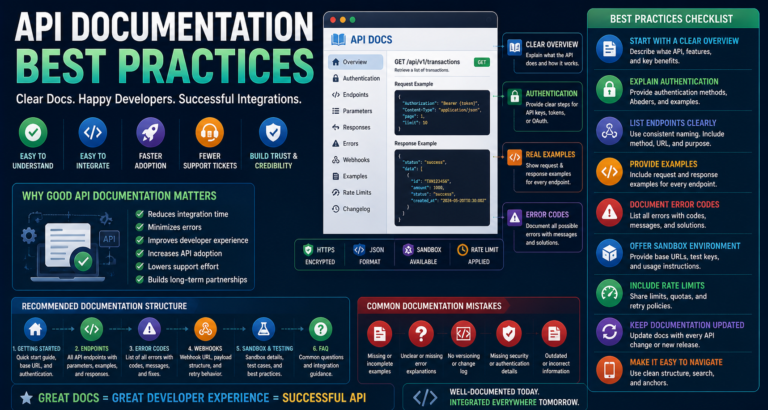
A well-built fintech API integration covers: proper OAuth 2.0 authentication, idempotency keys on every write request, webhook HMAC signature verification, exponential-backoff retry logic for transient errors, and a status-query fallback for ambiguous outcomes. NxtBanking's sandbox environment lets you test all these scenarios before production.
How do I handle failed transactions in a payment API?
Categorise failures: (1) Hard failures (invalid account, KYC mismatch) — do not retry; notify user. (2) Transient failures (timeout, 5xx) — retry with idempotency key and exponential back-off. (3) Ambiguous (no response) — call the transaction status endpoint before retrying to avoid duplicate processing.
Is NxtBanking RBI-compliant for payment APIs?
Yes. NxtBanking operates through RBI-licensed partner banks for all payment services (IMPS, NEFT, RTGS, UPI) and is NPCI-certified for BBPS, AEPS, and UPI flows. All APIs follow RBI's Master Directions on payment aggregators, KYC, and PMLA obligations. We maintain audit logs, data localisation, and consent frameworks compliant with the DPDP Act 2023.
How does NxtBanking handle API downtime and failover?
NxtBanking uses a connected-banking architecture that links a single API credential to multiple RBI-licensed partner banks. When one bank's rails experience degradation or maintenance, the API automatically routes to the next available bank — with no code change required on the client side. This multi-bank failover is what delivers 99%+ transaction success rates and 99.9% API uptime SLA for enterprise clients.
What does it cost to integrate NxtBanking APIs?
NxtBanking offers pay-as-you-go pricing with no setup fees and no minimum commitment for most APIs. Typical pricing: IMPS/UPI payout ₹3–₹8 per transaction, NEFT ₹1–₹3, BBPS bill payment ₹0.50–₹3, AEPS cash withdrawal ₹2–₹5. Enterprise clients on committed volumes negotiate flat-rate pricing. Sandbox access is free and unlimited. Contact sales for a custom quote based on your expected transaction volume.
Key Terms
- API
- Application Programming Interface — a structured software interface that lets applications communicate with each other over the internet using defined endpoints, authentication, and data formats.
NxtBanking is India's AI-powered fintech API platform trusted by hundreds of fintechs, BC networks, NBFCs, and enterprise companies. Our unified API marketplace covers payout (IMPS, NEFT, RTGS, UPI), BBPS bill payment with 20,000+ billers, AEPS biometric banking, KYC and identity verification (Aadhaar, PAN, Bank, Driving Licence, Voter ID, RC), UPI collection and QR codes, domestic money transfer (DMT), mobile and DTH recharge, Micro-ATM, and travel APIs — all under one master agreement, one set of credentials, and one consolidated monthly invoice.
Every NxtBanking API is backed by a 99.9% uptime SLA, real-time webhook delivery, a full-featured sandbox environment with simulated error scenarios, comprehensive API documentation with Postman collections and code samples in multiple languages, and dedicated technical onboarding support. Production go-live for most APIs is achievable within 7–15 business days after KYC and compliance review. For enterprise clients requiring custom SLAs, dedicated infrastructure, or white-label platform builds, NxtBanking offers tailored commercial terms with no minimum volume commitment at the pilot stage.