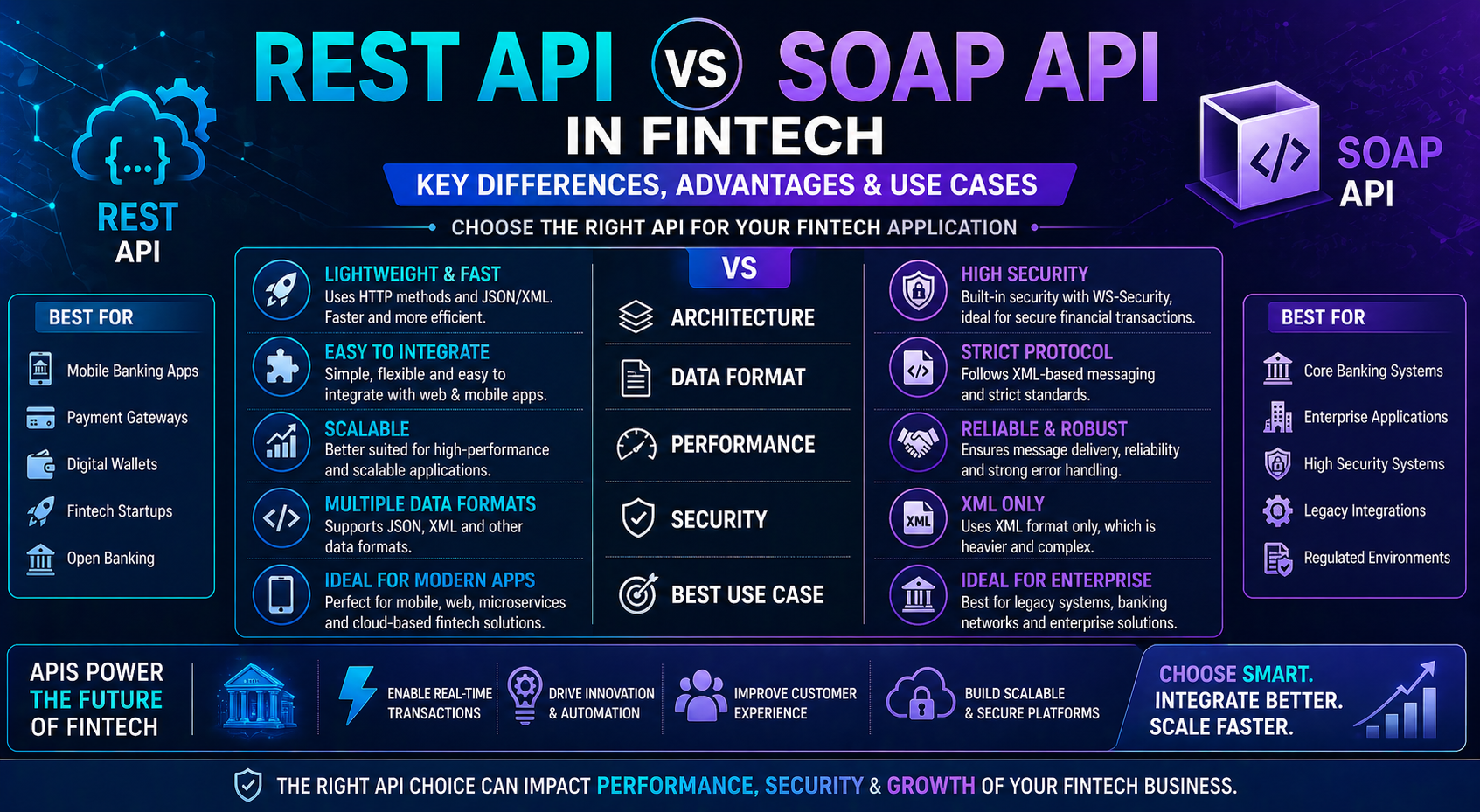
REST API vs SOAP API in Fintech: Key Differences and Use Cases (2026)
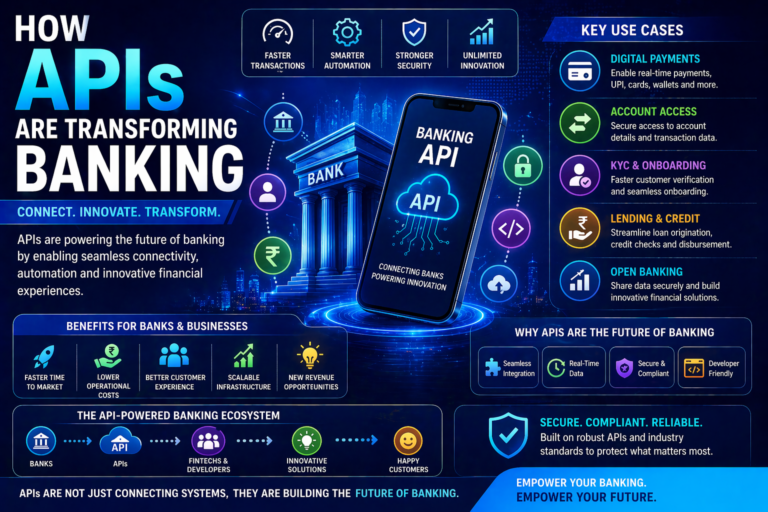
Understanding REST API vs SOAP API in fintech is essential for developers and businesses building financial applications. APIs play a critical role in enabling secure transactions, integrations, and communication between systems.
In India, fintech platforms rely heavily on APIs to provide services like payments, money transfers, and bill payments. Choosing between REST and SOAP APIs can significantly impact performance, scalability, and security.
What is a REST API
REST (Representational State Transfer) is a lightweight and flexible API architecture that uses HTTP protocols for communication.
Key characteristics:
- Uses JSON or XML formats
- Faster and lightweight
- Easy to integrate
- Stateless communication
What is a SOAP API
SOAP (Simple Object Access Protocol) is a protocol-based API that uses XML for message exchange.
Key characteristics:
- Strict structure
- High security standards
- Uses XML only
- Supports complex operations
Key Differences: REST API vs SOAP API in Fintech
Architecture
REST is an architectural style, while SOAP is a protocol with strict rules.
Data Format
REST supports JSON and XML, while SOAP uses only XML.
Performance
REST APIs are faster and more efficient. SOAP APIs are heavier due to XML processing.
Security
SOAP provides built-in security features like WS-Security. REST relies on HTTPS and tokens for security.
Flexibility
REST is more flexible and developer-friendly. SOAP is rigid but reliable.
Scalability
REST is better suited for scalable applications. SOAP is used for enterprise-level systems.
Why REST APIs are Popular in Fintech
The rise of digital platforms has made REST APIs more popular.
Reasons include:
- Faster response time
- Easy integration with mobile apps
- Lightweight data exchange
- Better scalability
Most modern fintech platforms prefer REST APIs for services like:
- Payments
- Wallets
- Money transfer
https://nxtbanking.com/dmt-api
https://nxtbanking.com/bbps-api
Where SOAP APIs are Used in Fintech
Despite REST dominance, SOAP APIs are still used in:
- Banking systems
- Enterprise financial services
- Secure transaction systems
- Legacy infrastructure
SOAP is preferred where:
- High security is required
- Complex transactions are involved
- Strict standards are needed
Advantages of REST API
Speed and Performance
REST APIs are faster due to lightweight structure.
Ease of Use
Simple to implement and integrate.
Scalability
Handles large traffic efficiently.
Compatibility
Works well with web and mobile applications.
Advantages of SOAP API
Strong Security
Built-in security features make it reliable.
Reliability
Ensures message delivery and error handling.
Standardization
Follows strict protocols for consistency.
Challenges of REST API
Security Dependency
Requires external security measures.
Lack of Standardization
Different implementations may vary.
Challenges of SOAP API
Complexity
Difficult to implement and maintain.
Performance Overhead
Slower due to XML processing.
Which API is Better for Fintech
The choice between REST API vs SOAP API in fintech depends on use case.
Choose REST API if
- You need fast performance
- You are building mobile or web apps
- You want scalability
Choose SOAP API if
- You need high security
- You are working with legacy systems
- You require strict compliance
Role of APIs in Fintech Growth
APIs are essential for fintech innovation by enabling:
- Real-time transactions
- Seamless integrations
- Scalable platforms
- Better user experience
https://www.rbi.org.in/
https://www.npci.org.in/
Future of APIs in Fintech
The future of APIs in fintech includes:
- REST dominance
- API-first architecture
- Open banking
- Microservices-based systems
APIs will continue to drive innovation and digital transformation.
Conclusion
The comparison of REST API vs SOAP API in fintech shows that both have their own strengths. REST APIs are ideal for modern, scalable applications, while SOAP APIs are suitable for secure and complex enterprise systems.
Choosing the right API depends on your business requirements, security needs, and scalability goals.
https://nxtbanking.com/contact
About This Topic
The NxtBanking blog is India's authoritative technical resource for fintech API integration — covering Payout API, BBPS, AEPS, UPI, KYC, DMT, recharge APIs, and enterprise payment infrastructure. Every article is written by practitioners who have built and scaled payment systems processing millions of transactions, combining technical accuracy with real-world implementation guidance for developers, product teams, and fintech founders.
Quick Answers
What makes a good fintech API integration?
A well-built fintech API integration covers: proper OAuth 2.0 authentication, idempotency keys on every write request, webhook HMAC signature verification, exponential-backoff retry logic for transient errors, and a status-query fallback for ambiguous outcomes. NxtBanking's sandbox environment lets you test all these scenarios before production.
How do I handle failed transactions in a payment API?
Categorise failures: (1) Hard failures (invalid account, KYC mismatch) — do not retry; notify user. (2) Transient failures (timeout, 5xx) — retry with idempotency key and exponential back-off. (3) Ambiguous (no response) — call the transaction status endpoint before retrying to avoid duplicate processing.
Is NxtBanking RBI-compliant for payment APIs?
Yes. NxtBanking operates through RBI-licensed partner banks for all payment services (IMPS, NEFT, RTGS, UPI) and is NPCI-certified for BBPS, AEPS, and UPI flows. All APIs follow RBI's Master Directions on payment aggregators, KYC, and PMLA obligations. We maintain audit logs, data localisation, and consent frameworks compliant with the DPDP Act 2023.
How does NxtBanking handle API downtime and failover?
NxtBanking uses a connected-banking architecture that links a single API credential to multiple RBI-licensed partner banks. When one bank's rails experience degradation or maintenance, the API automatically routes to the next available bank — with no code change required on the client side. This multi-bank failover is what delivers 99%+ transaction success rates and 99.9% API uptime SLA for enterprise clients.
What does it cost to integrate NxtBanking APIs?
NxtBanking offers pay-as-you-go pricing with no setup fees and no minimum commitment for most APIs. Typical pricing: IMPS/UPI payout ₹3–₹8 per transaction, NEFT ₹1–₹3, BBPS bill payment ₹0.50–₹3, AEPS cash withdrawal ₹2–₹5. Enterprise clients on committed volumes negotiate flat-rate pricing. Sandbox access is free and unlimited. Contact sales for a custom quote based on your expected transaction volume.
Key Terms
- API
- Application Programming Interface — a structured software interface that lets applications communicate with each other over the internet using defined endpoints, authentication, and data formats.
NxtBanking is India's AI-powered fintech API platform trusted by hundreds of fintechs, BC networks, NBFCs, and enterprise companies. Our unified API marketplace covers payout (IMPS, NEFT, RTGS, UPI), BBPS bill payment with 20,000+ billers, AEPS biometric banking, KYC and identity verification (Aadhaar, PAN, Bank, Driving Licence, Voter ID, RC), UPI collection and QR codes, domestic money transfer (DMT), mobile and DTH recharge, Micro-ATM, and travel APIs — all under one master agreement, one set of credentials, and one consolidated monthly invoice.
Every NxtBanking API is backed by a 99.9% uptime SLA, real-time webhook delivery, a full-featured sandbox environment with simulated error scenarios, comprehensive API documentation with Postman collections and code samples in multiple languages, and dedicated technical onboarding support. Production go-live for most APIs is achievable within 7–15 business days after KYC and compliance review. For enterprise clients requiring custom SLAs, dedicated infrastructure, or white-label platform builds, NxtBanking offers tailored commercial terms with no minimum volume commitment at the pilot stage.