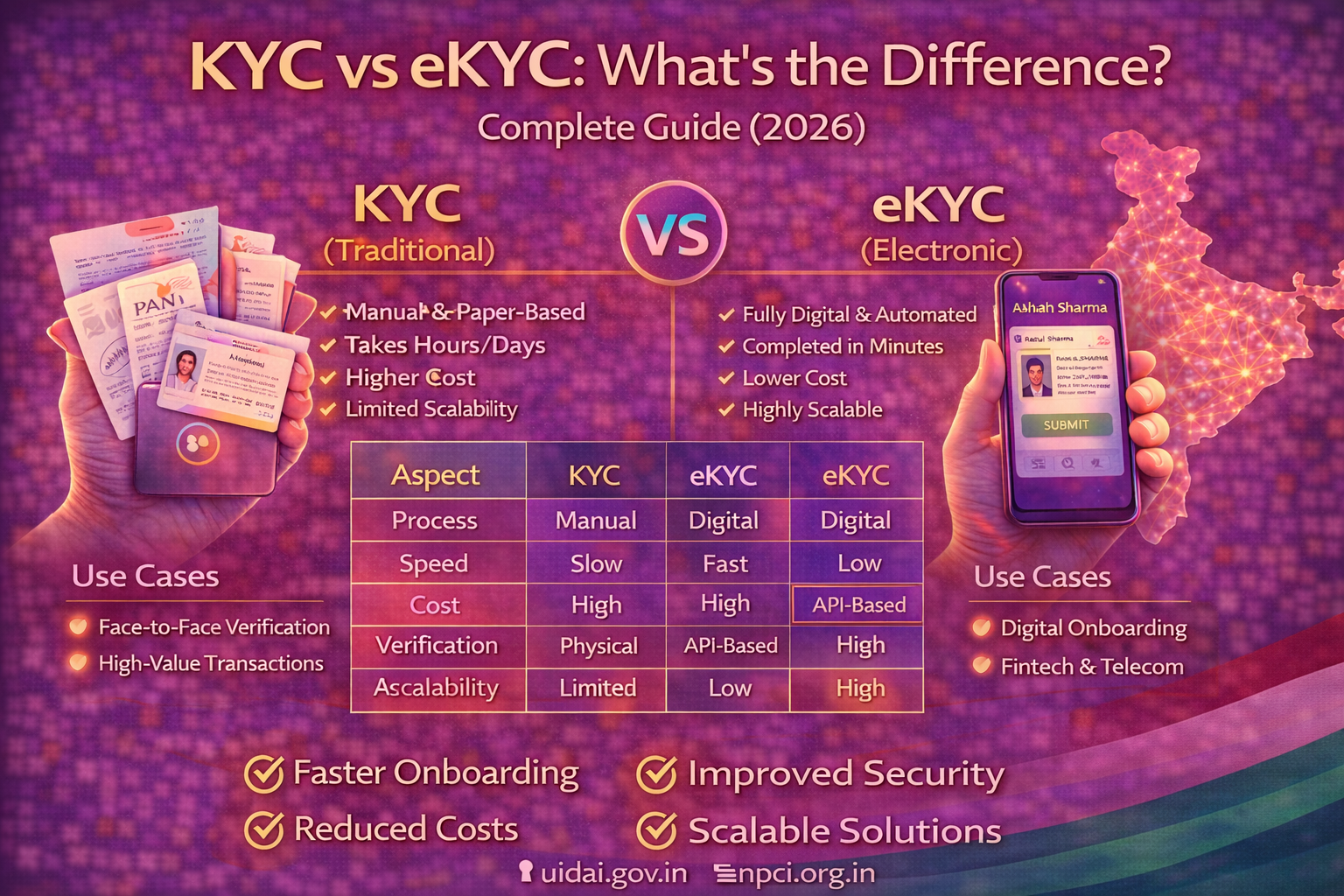
KYC vs eKYC: What’s the Difference? Complete Guide (2026)
Understanding KYC vs eKYC is essential for businesses dealing with customer onboarding and identity verification. While both processes aim to verify user identity, the way they operate is very different.
In India, the shift from traditional KYC to digital eKYC has significantly improved onboarding speed, security, and scalability. Knowing the difference between KYC vs eKYC helps businesses choose the right approach for their operations.
Inbound Link:
https://nxtbanking.com/aeps-api-provider
What is KYC
KYC (Know Your Customer) is a traditional process used to verify the identity of customers before providing financial services.
It usually involves:
- Physical document submission
- Manual verification
- In-person checks
- Paper-based records
KYC ensures that the customer is genuine and helps prevent fraud.
What is eKYC
eKYC (Electronic Know Your Customer) is a digital version of KYC that verifies identity using APIs and electronic systems.
It involves:
- Aadhaar-based verification
- OTP authentication
- Digital document verification
- API-based data validation
Most eKYC systems in India are supported by Unique Identification Authority of India.
Outbound Link:
https://uidai.gov.in/
Key Differences Between KYC vs eKYC
Process
- KYC: Manual and paper-based
- eKYC: Fully digital and automated
Speed
- KYC: Takes hours or days
- eKYC: Completed within minutes
User Experience
- KYC: Requires physical presence
- eKYC: Can be done remotely
Cost
- KYC: Higher operational cost
- eKYC: Lower cost due to automation
Security
- KYC: Depends on manual verification
- eKYC: Uses encryption and authentication
Scalability
- KYC: Limited scalability
- eKYC: Highly scalable for large user volumes
Comparison Table: KYC vs eKYC
| Feature | KYC | eKYC |
|---|---|---|
| Process | Manual | Digital |
| Speed | Slow | Fast |
| Cost | High | Low |
| Verification | Physical | API-based |
| Accessibility | Limited | Remote |
| Scalability | Low | High |
Advantages of KYC
Strong Physical Verification
Face-to-face verification ensures identity authenticity.
Widely Accepted
Traditional KYC is accepted across all sectors.
Useful for High-Risk Cases
Manual verification may be required for sensitive cases.
Advantages of eKYC
Faster Onboarding
Reduces onboarding time significantly.
Paperless Process
Eliminates physical documentation.
Cost Efficient
Reduces operational expenses.
Better User Experience
Simple and convenient process.
High Scalability
Supports large-scale onboarding.
Inbound Links:
https://nxtbanking.com/dmt-api
https://nxtbanking.com/blog/benefits-digital-kyc-fintech
Use Cases of KYC vs eKYC
KYC Use Cases
- High-value banking services
- Corporate onboarding
- Cases requiring manual verification
eKYC Use Cases
- Fintech apps
- Digital wallets
- Online account opening
- Lending platforms
- Telecom onboarding
When to Use KYC vs eKYC
Use KYC When
- Physical verification is required
- High-risk transactions are involved
- Regulatory conditions demand manual checks
Use eKYC When
- You need fast onboarding
- You want a digital-first system
- You are scaling your business
- You want lower operational cost
Challenges in KYC vs eKYC
KYC Challenges
- Time-consuming
- Expensive
- Manual errors
- Limited scalability
eKYC Challenges
- Requires technical integration
- Data privacy concerns
- Dependency on APIs
- Regulatory compliance
Outbound Links:
https://www.rbi.org.in/
https://www.npci.org.in/
Future of KYC vs eKYC
The future of KYC vs eKYC is moving toward:
- Fully digital onboarding
- AI-based verification
- Biometric authentication
- Real-time identity validation
- API-driven compliance systems
eKYC is expected to dominate as digital adoption increases.
FAQs
What is the main difference between KYC and eKYC
KYC is manual, while eKYC is digital and automated.
Is eKYC better than KYC
eKYC is faster and more scalable, but KYC is still used in certain cases.
Is eKYC secure
Yes, it uses encryption and authentication methods.
Can eKYC replace KYC completely
Not entirely, as some situations still require physical verification.
Conclusion
The comparison of KYC vs eKYC shows a clear shift toward digital identity verification. While traditional KYC still has its place in specific scenarios, eKYC offers speed, efficiency, and scalability that modern businesses need.
Choosing between KYC and eKYC depends on your business requirements, regulatory environment, and customer experience goals. In most cases, eKYC is the preferred solution for fintech and digital platforms.
Inbound Link:
https://nxtbanking.com/aeps-api-provider
About This Topic
The NxtBanking blog is India's authoritative technical resource for fintech API integration — covering Payout API, BBPS, AEPS, UPI, KYC, DMT, recharge APIs, and enterprise payment infrastructure. Every article is written by practitioners who have built and scaled payment systems processing millions of transactions, combining technical accuracy with real-world implementation guidance for developers, product teams, and fintech founders.
Quick Answers
What is KYC and why is it required in fintech?
KYC (Know Your Customer) is the mandatory identity verification process required by RBI under its Master Direction on KYC. It involves verifying a customer's identity (via Aadhaar, PAN, passport, or other documents) and address before onboarding them for financial services.
What is the difference between KYC and eKYC?
Traditional KYC uses physical document submission and in-person verification. eKYC (electronic KYC) uses Aadhaar OTP or biometric authentication via UIDAI for instant, paperless verification. eKYC is faster, cheaper, and enables digital-first onboarding for fintech apps.
Is NxtBanking RBI-compliant for payment APIs?
Yes. NxtBanking operates through RBI-licensed partner banks for all payment services (IMPS, NEFT, RTGS, UPI) and is NPCI-certified for BBPS, AEPS, and UPI flows. All APIs follow RBI's Master Directions on payment aggregators, KYC, and PMLA obligations. We maintain audit logs, data localisation, and consent frameworks compliant with the DPDP Act 2023.
How does NxtBanking handle API downtime and failover?
NxtBanking uses a connected-banking architecture that links a single API credential to multiple RBI-licensed partner banks. When one bank's rails experience degradation or maintenance, the API automatically routes to the next available bank — with no code change required on the client side. This multi-bank failover is what delivers 99%+ transaction success rates and 99.9% API uptime SLA for enterprise clients.
What does it cost to integrate NxtBanking APIs?
NxtBanking offers pay-as-you-go pricing with no setup fees and no minimum commitment for most APIs. Typical pricing: IMPS/UPI payout ₹3–₹8 per transaction, NEFT ₹1–₹3, BBPS bill payment ₹0.50–₹3, AEPS cash withdrawal ₹2–₹5. Enterprise clients on committed volumes negotiate flat-rate pricing. Sandbox access is free and unlimited. Contact sales for a custom quote based on your expected transaction volume.
Key Terms
- KYC
- Know Your Customer — the mandatory identity and address verification process required under RBI's Master Direction on KYC, using Aadhaar, PAN, and supporting documents.
NxtBanking is India's AI-powered fintech API platform trusted by hundreds of fintechs, BC networks, NBFCs, and enterprise companies. Our unified API marketplace covers payout (IMPS, NEFT, RTGS, UPI), BBPS bill payment with 20,000+ billers, AEPS biometric banking, KYC and identity verification (Aadhaar, PAN, Bank, Driving Licence, Voter ID, RC), UPI collection and QR codes, domestic money transfer (DMT), mobile and DTH recharge, Micro-ATM, and travel APIs — all under one master agreement, one set of credentials, and one consolidated monthly invoice.
Every NxtBanking API is backed by a 99.9% uptime SLA, real-time webhook delivery, a full-featured sandbox environment with simulated error scenarios, comprehensive API documentation with Postman collections and code samples in multiple languages, and dedicated technical onboarding support. Production go-live for most APIs is achievable within 7–15 business days after KYC and compliance review. For enterprise clients requiring custom SLAs, dedicated infrastructure, or white-label platform builds, NxtBanking offers tailored commercial terms with no minimum volume commitment at the pilot stage.