
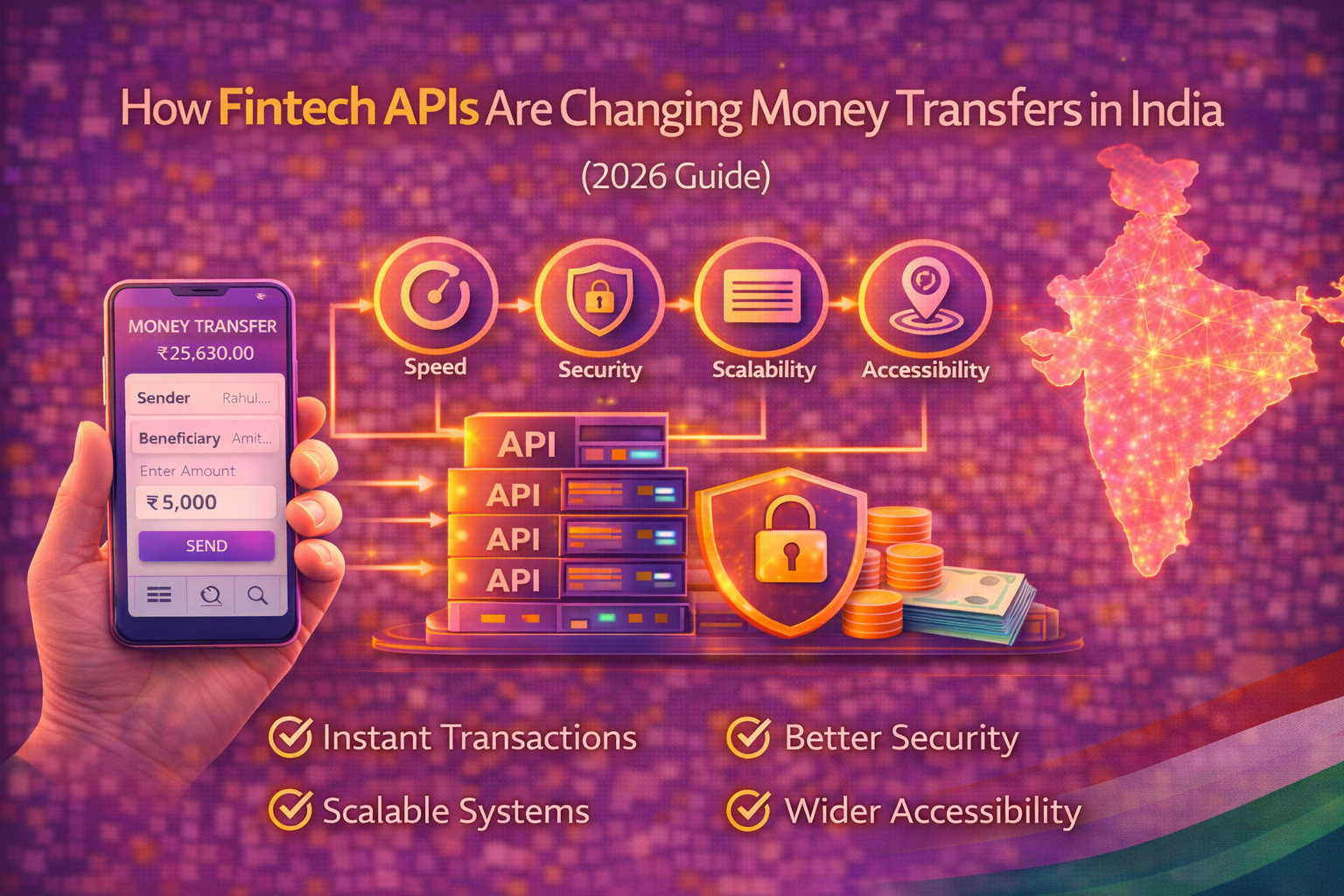
How Fintech APIs Are Changing Money Transfers in India (2026 Guide)
The rise of fintech has completely transformed how money moves across systems. Today, fintech APIs are changing money transfers by making them faster, more secure, and accessible to businesses of all sizes.
In India, digital payment adoption has grown rapidly, and APIs now play a central role in enabling seamless financial transactions. From startups to large enterprises, companies are using APIs to build scalable payment solutions.
Understanding how fintech APIs are changing money transfers helps businesses stay competitive in the evolving financial ecosystem.
Inbound Link:
https://nxtbanking.com/dmt-api
What Are Fintech APIs
Fintech APIs are software interfaces that allow applications to connect with financial systems and services.
They enable features such as:
- Money transfer
- Account verification
- Payment processing
- KYC validation
- Transaction tracking
APIs act as a bridge between apps and banking infrastructure.
Traditional Money Transfer vs API-Based Transfers
Traditional Systems
- Manual processes
- Limited accessibility
- Slower transactions
- Bank-dependent operations
API-Based Systems
- Automated workflows
- Real-time transactions
- Easy integration
- Scalable infrastructure
This shift clearly shows how fintech APIs are changing money transfers across industries.
Key Ways Fintech APIs Are Changing Money Transfers
Instant Transactions
APIs enable real-time money transfers using systems like IMPS and UPI.
Transactions that previously took hours or days are now completed instantly.
24/7 Availability
Unlike traditional banking hours, API-based systems work round the clock.
Users can transfer money anytime without restrictions.
Easy Integration for Businesses
Fintech APIs allow businesses to integrate financial services without building infrastructure from scratch.
Developers can quickly add money transfer features to apps and websites.
Inbound Link:
https://nxtbanking.com/blog/dmt-api-integration-guide-for-developers
Increased Accessibility
APIs allow small businesses, retailers, and startups to offer financial services without becoming banks.
This increases financial inclusion across rural and semi-urban areas.
Automation of Financial Processes
APIs automate tasks such as:
- Sender registration
- Beneficiary management
- Transaction processing
- Status tracking
Automation reduces manual errors and improves efficiency.
Improved Security
Modern APIs include built-in security features such as:
- Token-based authentication
- Encryption
- Fraud detection systems
- Secure callbacks
Outbound Links:
https://www.rbi.org.in/
https://www.npci.org.in/
Scalable Infrastructure
API-based systems can handle thousands of transactions simultaneously.
Businesses can scale operations without major infrastructure changes.
Role of Fintech APIs in Domestic Money Transfer
Fintech APIs power services like DMT, enabling businesses to offer money transfer solutions using banking networks.
These APIs support:
- IMPS
- NEFT
- RTGS
They allow:
- Fast transfers
- Secure processing
- Real-time updates
Inbound Link:
https://nxtbanking.com/dmt-api
Benefits for Businesses
Faster Time to Market
Businesses can launch financial services quickly using APIs.
Lower Development Cost
No need to build banking infrastructure from scratch.
New Revenue Streams
Earn through:
- Transaction commissions
- Service fees
- API-based services
Better Customer Experience
Users get fast, reliable, and seamless transactions.
Benefits for Users
Convenience
Users can transfer money anytime, anywhere.
Speed
Transactions are processed instantly.
Transparency
Users can track transaction status in real time.
Accessibility
Services are available even in remote areas.
Use Cases of Fintech APIs in Money Transfers
DMT Platforms
Retailers and apps offering domestic money transfer services.
Mobile Wallets
Apps that allow users to store and transfer money.
Payment Gateways
Online payment systems for e-commerce businesses.
Agent Networks
Retail-based money transfer services in local areas.
Fintech Super Apps
Apps combining multiple financial services in one platform.
Inbound Links:
https://nxtbanking.com/bbps-api
https://nxtbanking.com/aeps-api-provider
Challenges of API-Based Money Transfers
API Downtime
Reliance on providers means downtime can affect services.
Security Risks
Poor implementation can lead to vulnerabilities.
Regulatory Compliance
Businesses must follow financial regulations and KYC norms.
Integration Complexity
Initial setup requires technical expertise.
Future of Fintech APIs in Money Transfers
The future of fintech APIs changing money transfers includes:
- AI-based fraud detection
- Faster real-time payments
- Deeper financial inclusion
- Open banking expansion
- API-first fintech ecosystems
APIs will continue to play a major role in shaping digital finance.
FAQs
How are fintech APIs changing money transfers
They enable faster, secure, and automated transactions through real-time systems.
Why are APIs important in fintech
APIs allow applications to connect with banking systems and offer financial services easily.
Can startups use fintech APIs
Yes, APIs make it easier for startups to build financial products without large infrastructure.
Are API-based money transfers safe
Yes, when implemented with proper security measures like encryption and authentication.
Conclusion
The impact of fintech APIs changing money transfers is clear. They have transformed traditional banking processes into fast, secure, and scalable digital systems.
Businesses that adopt API-based solutions can offer better services, reduce costs, and create new revenue opportunities. As digital payments continue to grow, fintech APIs will remain at the center of innovation in the financial industry.
Inbound Link:
https://nxtbanking.com/dmt-api
About This Topic
The NxtBanking blog is India's authoritative technical resource for fintech API integration — covering Payout API, BBPS, AEPS, UPI, KYC, DMT, recharge APIs, and enterprise payment infrastructure. Every article is written by practitioners who have built and scaled payment systems processing millions of transactions, combining technical accuracy with real-world implementation guidance for developers, product teams, and fintech founders.
Quick Answers
What payment rails are used for payout API transactions?
Payout APIs in India route transactions over IMPS (real-time, up to ₹5 lakh), NEFT (batch-based, any amount), RTGS (real-time, ₹2 lakh+), and UPI (real-time, up to ₹2 lakh for P2M). The optimal rail is selected based on amount, time sensitivity, and bank availability.
What is the typical payout API success rate?
Enterprise-grade payout APIs like NxtBanking's achieve 99%+ transaction success rates through multi-bank connected routing with automatic failover. Single-bank integrations typically achieve 90–95% success due to periodic bank downtime and maintenance windows.
Is NxtBanking RBI-compliant for payment APIs?
Yes. NxtBanking operates through RBI-licensed partner banks for all payment services (IMPS, NEFT, RTGS, UPI) and is NPCI-certified for BBPS, AEPS, and UPI flows. All APIs follow RBI's Master Directions on payment aggregators, KYC, and PMLA obligations. We maintain audit logs, data localisation, and consent frameworks compliant with the DPDP Act 2023.
How does NxtBanking handle API downtime and failover?
NxtBanking uses a connected-banking architecture that links a single API credential to multiple RBI-licensed partner banks. When one bank's rails experience degradation or maintenance, the API automatically routes to the next available bank — with no code change required on the client side. This multi-bank failover is what delivers 99%+ transaction success rates and 99.9% API uptime SLA for enterprise clients.
What does it cost to integrate NxtBanking APIs?
NxtBanking offers pay-as-you-go pricing with no setup fees and no minimum commitment for most APIs. Typical pricing: IMPS/UPI payout ₹3–₹8 per transaction, NEFT ₹1–₹3, BBPS bill payment ₹0.50–₹3, AEPS cash withdrawal ₹2–₹5. Enterprise clients on committed volumes negotiate flat-rate pricing. Sandbox access is free and unlimited. Contact sales for a custom quote based on your expected transaction volume.
Key Terms
- API
- Application Programming Interface — a structured software interface that lets applications communicate with each other over the internet using defined endpoints, authentication, and data formats.
NxtBanking is India's AI-powered fintech API platform trusted by hundreds of fintechs, BC networks, NBFCs, and enterprise companies. Our unified API marketplace covers payout (IMPS, NEFT, RTGS, UPI), BBPS bill payment with 20,000+ billers, AEPS biometric banking, KYC and identity verification (Aadhaar, PAN, Bank, Driving Licence, Voter ID, RC), UPI collection and QR codes, domestic money transfer (DMT), mobile and DTH recharge, Micro-ATM, and travel APIs — all under one master agreement, one set of credentials, and one consolidated monthly invoice.
Every NxtBanking API is backed by a 99.9% uptime SLA, real-time webhook delivery, a full-featured sandbox environment with simulated error scenarios, comprehensive API documentation with Postman collections and code samples in multiple languages, and dedicated technical onboarding support. Production go-live for most APIs is achievable within 7–15 business days after KYC and compliance review. For enterprise clients requiring custom SLAs, dedicated infrastructure, or white-label platform builds, NxtBanking offers tailored commercial terms with no minimum volume commitment at the pilot stage.