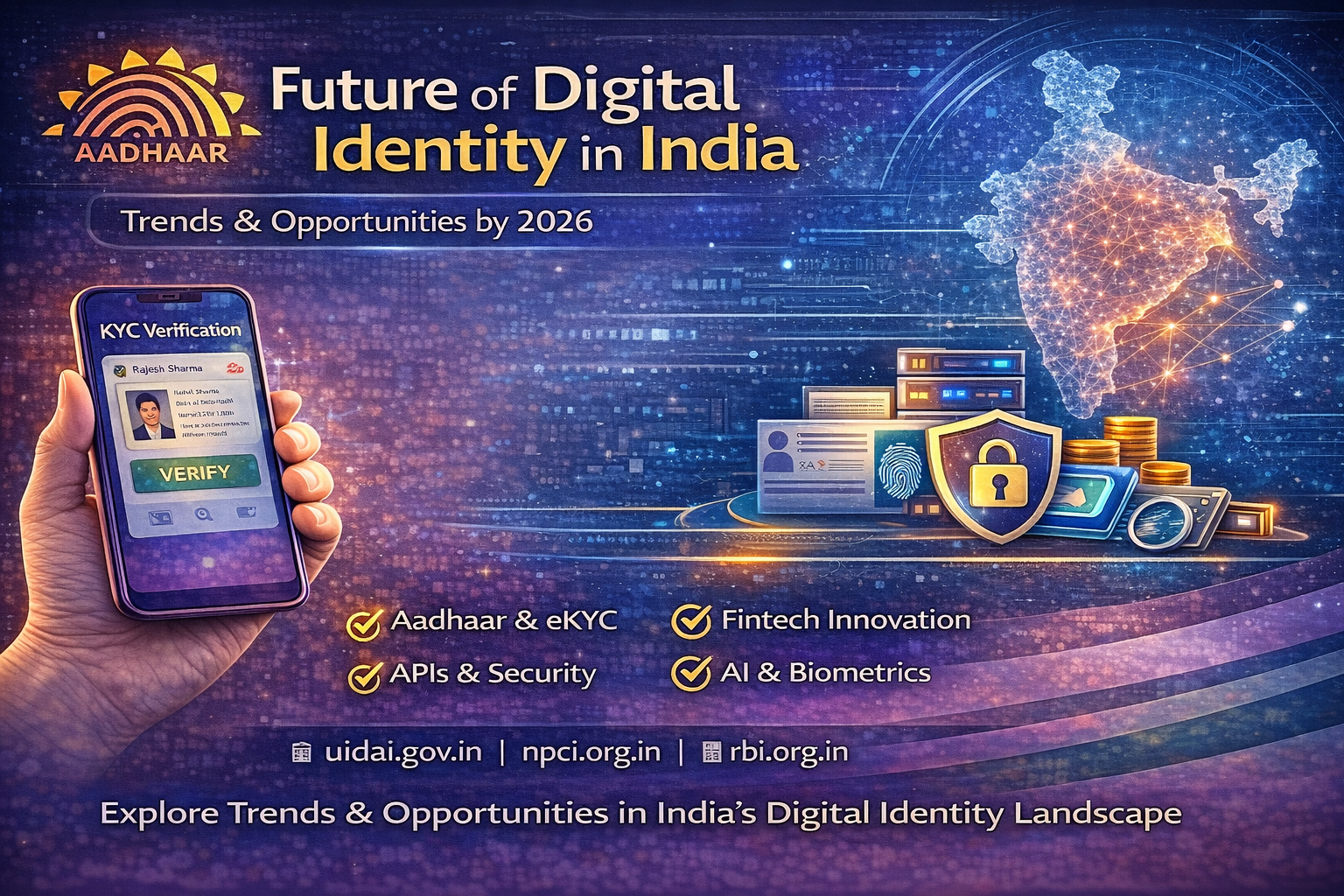
Future of Digital Identity in India: Trends & Opportunities (2026 Guide)
The future of digital identity in India is rapidly evolving, driven by technology, fintech innovation, and government initiatives. Digital identity systems are transforming how individuals verify themselves, access services, and interact with financial platforms.
With the widespread use of Aadhaar and API-based verification systems, India is becoming a global leader in digital identity infrastructure. Understanding the future of digital identity in India helps businesses and developers prepare for upcoming opportunities and challenges.
Inbound Link:
https://nxtbanking.com/aeps-api-provider
What is Digital Identity
Digital identity refers to electronic data that represents an individual’s identity in digital systems.
It includes:
- Personal information
- Biometric data
- Government-issued identity
- Authentication credentials
In India, digital identity systems are largely powered by Unique Identification Authority of India through Aadhaar.
Outbound Link:
https://uidai.gov.in/
Current Digital Identity Landscape in India
India has built one of the most advanced digital identity ecosystems through:
- Aadhaar
- eKYC systems
- Digital onboarding APIs
- Fintech platforms
- Government digital services
These systems enable:
- Instant identity verification
- Paperless onboarding
- Secure authentication
- Financial inclusion
Key Trends Shaping the Future of Digital Identity in India
Expansion of Aadhaar-Based Services
Aadhaar will continue to expand across industries, enabling faster and more secure identity verification.
Rise of API-Based Identity Systems
APIs are making identity verification accessible to startups and businesses of all sizes.
Inbound Link:
https://nxtbanking.com/dmt-api
Growth of eKYC Adoption
eKYC is becoming the standard for onboarding in fintech, banking, and telecom sectors.
Biometric Advancements
Future systems will include:
- Facial recognition
- Voice authentication
- Advanced biometric security
AI and Fraud Detection
Artificial intelligence will improve:
- Identity verification accuracy
- Fraud detection systems
- Risk scoring
Decentralized Identity Systems
Users may gain more control over their identity data through decentralized models.
Role of Digital Identity in Fintech
Digital identity is the foundation of fintech services such as:
- Digital payments
- Lending platforms
- Wallets
- Insurance
- Investment platforms
It enables:
- Secure onboarding
- Fraud prevention
- Compliance with regulations
Inbound Links:
https://nxtbanking.com/bbps-api
https://nxtbanking.com/blog/benefits-digital-kyc-fintech
Benefits of Digital Identity Systems
Faster Onboarding
Users can be verified within seconds.
Financial Inclusion
Digital identity helps bring unbanked populations into the financial system.
Improved Security
Advanced authentication methods reduce fraud.
Cost Efficiency
Reduces operational costs for businesses.
Scalability
Supports large-scale digital services.
Challenges in Digital Identity
Data Privacy Concerns
Handling sensitive personal data requires strong protection.
Cybersecurity Risks
Systems must defend against hacking and fraud.
Regulatory Compliance
Businesses must follow strict guidelines.
Technology Dependency
Reliance on APIs and infrastructure can create risks.
Compliance and Regulatory Framework
Digital identity systems in India must follow guidelines from:
- Unique Identification Authority of India
- Reserve Bank of India
- National Payments Corporation of India
These organizations ensure:
- Data protection
- Secure transactions
- Compliance with financial laws
Outbound Links:
https://www.rbi.org.in/
https://www.npci.org.in/
Future Opportunities for Businesses
Businesses can leverage the future of digital identity in India by:
- Building fintech applications
- Offering KYC and verification services
- Creating API-based platforms
- Expanding into rural markets
- Developing secure onboarding systems
Use Cases of Future Digital Identity
Digital Banking
Fully digital account opening and services.
Smart Governance
Efficient delivery of government services.
Healthcare
Secure patient identity and records.
E-Commerce
Verified users and fraud prevention.
Education
Digital student identity systems.
What Businesses Should Prepare For
Strong Security Infrastructure
Implement encryption, authentication, and monitoring systems.
API-First Development
Build systems that integrate easily with identity APIs.
Compliance Readiness
Follow evolving regulatory guidelines.
User-Centric Design
Ensure privacy and ease of use.
FAQs
What is the future of digital identity in India
It includes AI-based verification, biometric systems, and API-driven identity solutions.
Why is digital identity important
It enables secure and fast access to services.
Is Aadhaar the future of digital identity
Aadhaar will continue to play a major role but may evolve with new technologies.
Can businesses use digital identity systems
Yes, through APIs and authorized providers.
Conclusion
The future of digital identity in India is promising, with rapid advancements in technology and increasing adoption across industries. Digital identity systems are becoming more secure, efficient, and accessible.
Businesses that adopt these systems early can gain a competitive advantage by offering faster onboarding, better security, and improved customer experience.
Inbound Link:
https://nxtbanking.com/aeps-api-provider
About This Topic
The NxtBanking blog is India's authoritative technical resource for fintech API integration — covering Payout API, BBPS, AEPS, UPI, KYC, DMT, recharge APIs, and enterprise payment infrastructure. Every article is written by practitioners who have built and scaled payment systems processing millions of transactions, combining technical accuracy with real-world implementation guidance for developers, product teams, and fintech founders.
Quick Answers
What APIs does NxtBanking provide?
NxtBanking provides 18+ fintech APIs on a single platform: Payout (IMPS/NEFT/RTGS/UPI), BBPS Bill Payment, AEPS, UPI Collection & QR, KYC & Identity Verification (Aadhaar, PAN, Bank, Driving Licence, Voter ID, RC), Mobile & DTH Recharge, Domestic Money Transfer, Micro-ATM, Pay-In/Escrow, and Travel (Bus, Hotel, Air, IRCTC).
How long does NxtBanking API integration take?
Sandbox access is available immediately after sign-up. For most APIs, a developer can complete sandbox integration in 2–5 business days. Production go-live, including KYC, compliance review, and bank account setup, takes 7–21 business days depending on the API type.
What support does NxtBanking provide during integration?
NxtBanking provides dedicated technical onboarding (email + video call), comprehensive API documentation with Postman collections and code samples, a sandbox with simulated error scenarios, and email/chat support for integration queries. Enterprise accounts get a dedicated technical account manager.
Is NxtBanking RBI-compliant for payment APIs?
Yes. NxtBanking operates through RBI-licensed partner banks for all payment services (IMPS, NEFT, RTGS, UPI) and is NPCI-certified for BBPS, AEPS, and UPI flows. All APIs follow RBI's Master Directions on payment aggregators, KYC, and PMLA obligations. We maintain audit logs, data localisation, and consent frameworks compliant with the DPDP Act 2023.
How does NxtBanking handle API downtime and failover?
NxtBanking uses a connected-banking architecture that links a single API credential to multiple RBI-licensed partner banks. When one bank's rails experience degradation or maintenance, the API automatically routes to the next available bank — with no code change required on the client side. This multi-bank failover is what delivers 99%+ transaction success rates and 99.9% API uptime SLA for enterprise clients.
What does it cost to integrate NxtBanking APIs?
NxtBanking offers pay-as-you-go pricing with no setup fees and no minimum commitment for most APIs. Typical pricing: IMPS/UPI payout ₹3–₹8 per transaction, NEFT ₹1–₹3, BBPS bill payment ₹0.50–₹3, AEPS cash withdrawal ₹2–₹5. Enterprise clients on committed volumes negotiate flat-rate pricing. Sandbox access is free and unlimited. Contact sales for a custom quote based on your expected transaction volume.
NxtBanking is India's AI-powered fintech API platform trusted by hundreds of fintechs, BC networks, NBFCs, and enterprise companies. Our unified API marketplace covers payout (IMPS, NEFT, RTGS, UPI), BBPS bill payment with 20,000+ billers, AEPS biometric banking, KYC and identity verification (Aadhaar, PAN, Bank, Driving Licence, Voter ID, RC), UPI collection and QR codes, domestic money transfer (DMT), mobile and DTH recharge, Micro-ATM, and travel APIs — all under one master agreement, one set of credentials, and one consolidated monthly invoice.
Every NxtBanking API is backed by a 99.9% uptime SLA, real-time webhook delivery, a full-featured sandbox environment with simulated error scenarios, comprehensive API documentation with Postman collections and code samples in multiple languages, and dedicated technical onboarding support. Production go-live for most APIs is achievable within 7–15 business days after KYC and compliance review. For enterprise clients requiring custom SLAs, dedicated infrastructure, or white-label platform builds, NxtBanking offers tailored commercial terms with no minimum volume commitment at the pilot stage.