How to Test Fintech APIs: Complete Testing Guide for Developers (2026)
Understanding how to test fintech APIs is critical for building secure and reliable financial applications. Fintech APIs handle sensitive data, transactions, and real-time operations, so proper testing ensures performance, accuracy, and security.
In India, fintech platforms rely heavily on APIs for services like payments, money transfers, and bill payments. Testing these APIs thoroughly helps prevent failures, fraud, and poor user experience.
What is Fintech API Testing
Fintech API testing is the process of verifying that financial APIs work correctly, securely, and efficiently under different conditions.
It ensures:
- Accurate transactionsJMeter
- Secure data handling
- Reliable performance
- Proper error handling
Why API Testing is Important in Fintech
Testing fintech APIs is important because:
- Financial data is sensitive
- Transactions must be accurate
- Errors can cause financial loss
- Systems must be highly reliable
https://owasp.org/www-project-api-security/
https://developer.mozilla.org/en-US/docs/Web/API
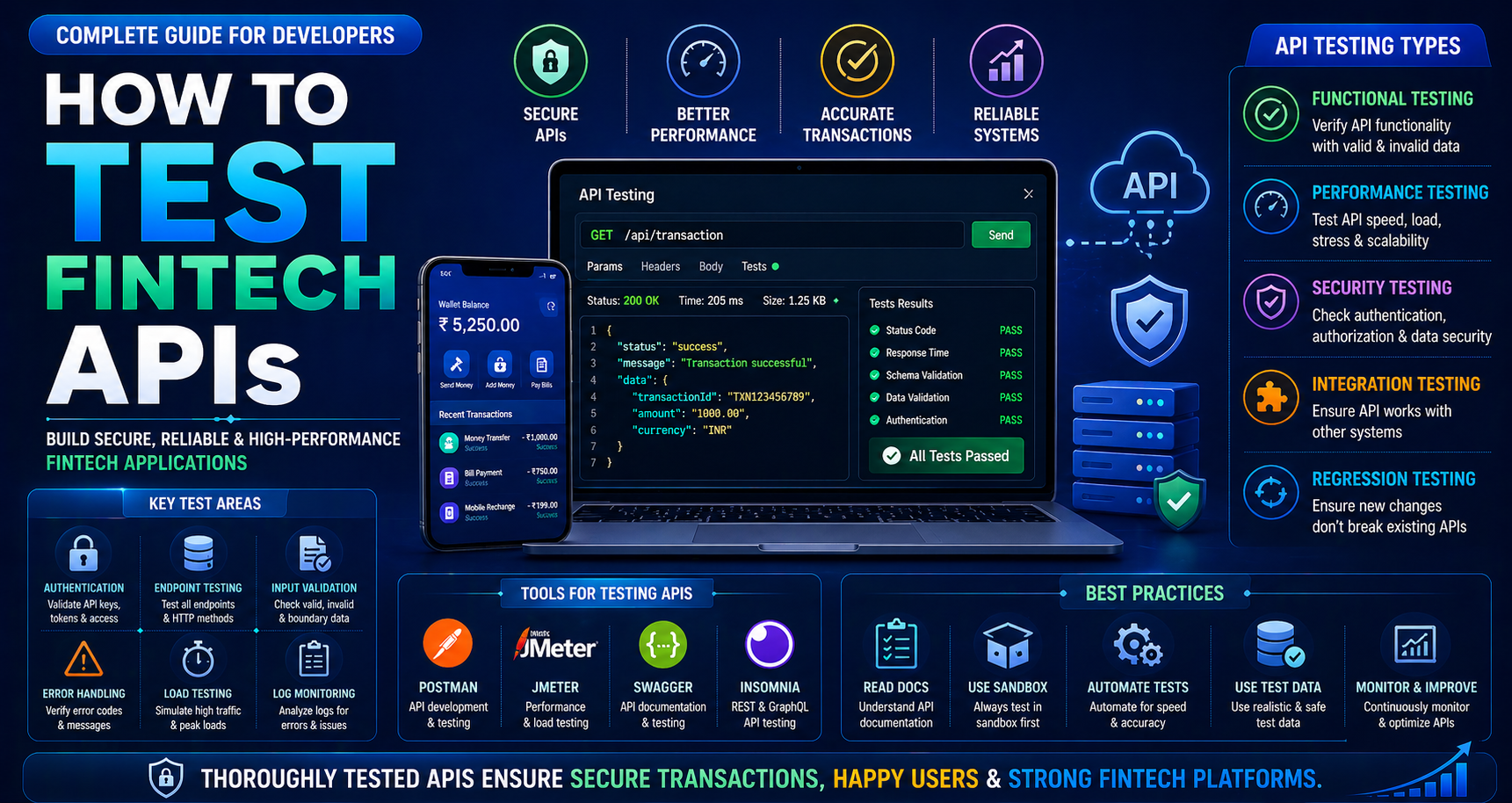
Types of Fintech API Testing
Functional Testing
Checks if the API works as expected.
Example:
- Correct response for valid request
- Proper error for invalid input
Performance Testing
Measures how the API performs under load.
- Response time
- Throughput
- Scalability
Security Testing
Ensures API is protected from threats.
- Authentication validation
- Authorization checks
- Data encryption
Integration Testing
Tests how API interacts with other systems.
Regression Testing
Ensures new changes do not break existing functionality.
Step-by-Step Process to Test Fintech APIs
Step 1: Understand API Documentation
Before testing, review:
- Endpoints
- Request parameters
- Response format
- Authentication methods
Step 2: Setup Testing Environment
Use sandbox or staging environment provided by API provider.
https://nxtbanking.com/dmt-api
https://nxtbanking.com/bbps-api
Step 3: Validate Authentication
Test:
- API keys
- Tokens
- Expired credentials
- Unauthorized access
Step 4: Test API Endpoints
Verify:
- GET requests
- POST requests
- PUT requests
- DELETE requests
Check response codes like:
- 200 (success)
- 400 (bad request)
- 401 (unauthorized)
- 500 (server error)
Step 5: Test Input Validation
Check:
- Invalid data
- Missing parameters
- Boundary values
Step 6: Test Transaction Flow
For fintech APIs, test complete flow:
- Request initiation
- Processing
- Status update
- Confirmation
Step 7: Test Error Handling
Ensure meaningful error messages are returned.
Step 8: Perform Load Testing
Simulate high traffic to check performance.
Step 9: Test Security Measures
Check:
- HTTPS usage
- Token validation
- Data encryption
- Access control
Step 10: Monitor Logs and Reports
Analyze logs for:
- Errors
- Failed transactions
- Performance issues
Tools for Testing Fintech APIs
Postman
Popular tool for API testing.JMeter
Used for performance and load testing.
Swagger
Helps in testing and documentation.
Insomnia
Alternative API testing tool.
Common Challenges in Fintech API Testing
Data Sensitivity
Handling financial data securely is challenging.
Complex Workflows
Multi-step transactions require careful testing.
Real-Time Processing
Ensuring instant responses under load.Compliance Requirements
Following regulatory standards.
Best Practices for Testing Fintech APIs
Use Sandbox Environment
Always test before going live.
Automate Testing
Use automated scripts for repeated testing.
Test Edge Cases
Include unusual and extreme scenarios.
Maintain Test Data
Use realistic but safe test data.
Monitor Performance
Continuously track API performance.
Security Checklist for Fintech API Testing
Authentication
Ensure only authorized users can access APIs.
Authorization
Check role-based access control.
Encryption
Use HTTPS and secure protocols.
Rate Limiting
Prevent abuse by limiting requests.
ogging
Maintain audit logs for transactions.
Use Cases of Fintech API Testing
- Payment APIs
- Money transfer APIs
- Banking APIs
- Wallet services
https://nxtbanking.com/aeps-api-provider
Conclusion
Learning how to test fintech APIs is essential for building secure and reliable financial applications. Proper testing ensures accurate transactions, strong security, and smooth user experience.
By following structured testing methods and best practices, developers can build robust fintech systems that perform well under real-world conditions.
https://nxtbanking.com/contact
About This Topic
The NxtBanking blog is India's authoritative technical resource for fintech API integration — covering Payout API, BBPS, AEPS, UPI, KYC, DMT, recharge APIs, and enterprise payment infrastructure. Every article is written by practitioners who have built and scaled payment systems processing millions of transactions, combining technical accuracy with real-world implementation guidance for developers, product teams, and fintech founders.
Quick Answers
What makes a good fintech API integration?
A well-built fintech API integration covers: proper OAuth 2.0 authentication, idempotency keys on every write request, webhook HMAC signature verification, exponential-backoff retry logic for transient errors, and a status-query fallback for ambiguous outcomes. NxtBanking's sandbox environment lets you test all these scenarios before production.
How do I handle failed transactions in a payment API?
Categorise failures: (1) Hard failures (invalid account, KYC mismatch) — do not retry; notify user. (2) Transient failures (timeout, 5xx) — retry with idempotency key and exponential back-off. (3) Ambiguous (no response) — call the transaction status endpoint before retrying to avoid duplicate processing.
Is NxtBanking RBI-compliant for payment APIs?
Yes. NxtBanking operates through RBI-licensed partner banks for all payment services (IMPS, NEFT, RTGS, UPI) and is NPCI-certified for BBPS, AEPS, and UPI flows. All APIs follow RBI's Master Directions on payment aggregators, KYC, and PMLA obligations. We maintain audit logs, data localisation, and consent frameworks compliant with the DPDP Act 2023.
How does NxtBanking handle API downtime and failover?
NxtBanking uses a connected-banking architecture that links a single API credential to multiple RBI-licensed partner banks. When one bank's rails experience degradation or maintenance, the API automatically routes to the next available bank — with no code change required on the client side. This multi-bank failover is what delivers 99%+ transaction success rates and 99.9% API uptime SLA for enterprise clients.
What does it cost to integrate NxtBanking APIs?
NxtBanking offers pay-as-you-go pricing with no setup fees and no minimum commitment for most APIs. Typical pricing: IMPS/UPI payout ₹3–₹8 per transaction, NEFT ₹1–₹3, BBPS bill payment ₹0.50–₹3, AEPS cash withdrawal ₹2–₹5. Enterprise clients on committed volumes negotiate flat-rate pricing. Sandbox access is free and unlimited. Contact sales for a custom quote based on your expected transaction volume.
Key Terms
- API
- Application Programming Interface — a structured software interface that lets applications communicate with each other over the internet using defined endpoints, authentication, and data formats.
NxtBanking is India's AI-powered fintech API platform trusted by hundreds of fintechs, BC networks, NBFCs, and enterprise companies. Our unified API marketplace covers payout (IMPS, NEFT, RTGS, UPI), BBPS bill payment with 20,000+ billers, AEPS biometric banking, KYC and identity verification (Aadhaar, PAN, Bank, Driving Licence, Voter ID, RC), UPI collection and QR codes, domestic money transfer (DMT), mobile and DTH recharge, Micro-ATM, and travel APIs — all under one master agreement, one set of credentials, and one consolidated monthly invoice.
Every NxtBanking API is backed by a 99.9% uptime SLA, real-time webhook delivery, a full-featured sandbox environment with simulated error scenarios, comprehensive API documentation with Postman collections and code samples in multiple languages, and dedicated technical onboarding support. Production go-live for most APIs is achievable within 7–15 business days after KYC and compliance review. For enterprise clients requiring custom SLAs, dedicated infrastructure, or white-label platform builds, NxtBanking offers tailored commercial terms with no minimum volume commitment at the pilot stage.