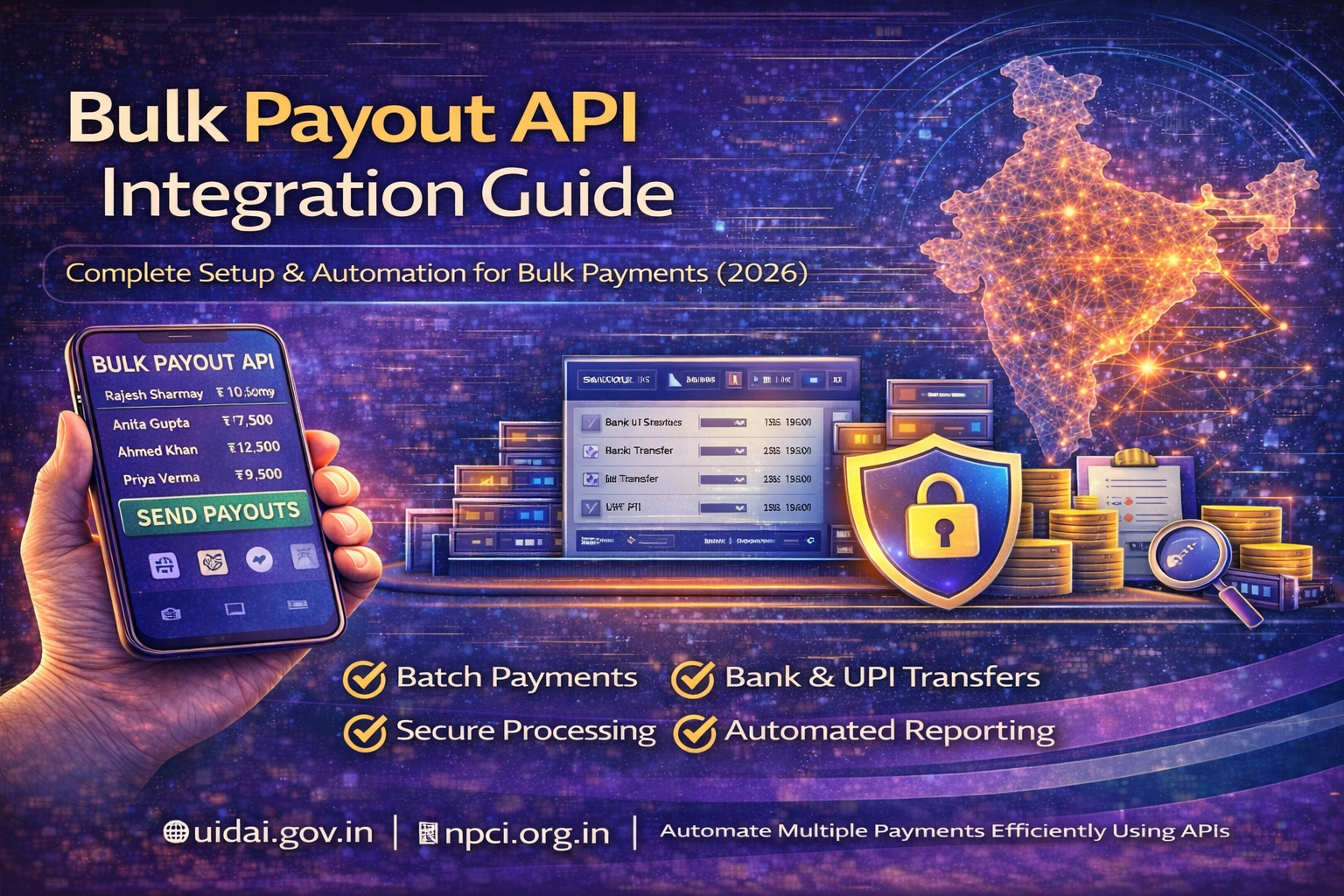
Bulk Payout API Integration Guide: Complete Setup (2026)
If your business handles high-volume transactions like salaries, vendor payments, commissions, or refunds, this bulk payout API integration guide will help you automate and scale your payment operations.
In India, businesses are rapidly adopting API-based payout systems to handle thousands of transactions efficiently. Using a bulk payout API, companies can process multiple payments in a single request, saving time and reducing manual effort.
Understanding this bulk payout API integration guide will help you build a secure, scalable, and efficient payment system.
Inbound Link:
https://nxtbanking.com/dmt-api
What is Bulk Payout API
A bulk payout API allows businesses to send money to multiple beneficiaries in a single request instead of processing each payment individually.
It supports:
- Bank transfers (IMPS, NEFT, RTGS)
- UPI payouts
- Wallet transfers
- Batch processing
- Real-time status updates
These APIs operate on payment systems managed by National Payments Corporation of India.
Outbound Links:
https://www.npci.org.in/
https://www.rbi.org.in/
How Bulk Payout API Works
Step-by-Step Flow
- Business uploads payout list
- API validates beneficiary details
- Batch request is created
- Payments are processed via banking network
- Status is updated for each transaction
- Final report is generated
Key Features of Bulk Payout API
Batch Processing
Process multiple transactions at once.
Real-Time Tracking
Track each payout status individually.
Multi-Mode Payments
Supports IMPS, NEFT, RTGS, and UPI.
Secure Transactions
Uses encryption and authentication.
Easy Integration
Developer-friendly APIs and documentation.
Automated Reporting
Generate reports for reconciliation.
Use Cases of Bulk Payout API
Salary Payments
Disburse salaries to employees in bulk.
Vendor Settlements
Pay multiple suppliers in one go.
Commission Distribution
Distribute earnings to agents and partners.
Refund Processing
Handle bulk refunds for customers.
Cashback and Rewards
Credit incentives to users automatically.
Inbound Links:
https://nxtbanking.com/bbps-api
https://nxtbanking.com/aeps-api-provider
Components Required for Bulk Payout Integration
Beneficiary Management
Store and verify recipient details.
Batch Processing System
Handles multiple payout requests.
API Integration Layer
Connects your system with payout provider.
Approval Workflow
Ensures payments are authorized before execution.
Reporting System
Tracks and reconciles transactions.
Step-by-Step Bulk Payout API Integration Guide
Step 1: Choose a Payout API Provider
Select a provider with:
- High uptime
- Fast processing
- Bulk support
- Good documentation
Inbound Link:
https://nxtbanking.com/contact
Step 2: Get API Credentials
Receive:
- API key
- Client ID
- Secret key
- Sandbox access
Step 3: Prepare Payout Data
Create structured data with:
- Beneficiary name
- Account number
- IFSC code
- Amount
- Reference ID
Step 4: Build Batch Request
Group multiple transactions into a single API request.
Step 5: Integrate API Endpoints
Implement:
- Payout initiation
- Batch upload
- Status check
- Webhook handling
Step 6: Add Validation Logic
Validate:
- Account details
- Amount limits
- Duplicate entries
Step 7: Implement Approval Workflow
Add approval layer for:
- High-value transactions
- Bulk payouts
- Compliance checks
Step 8: Handle API Response
Process:
- Success status
- Failed transactions
- Pending payouts
Step 9: Test in Sandbox
Test scenarios:
- Valid batch
- Invalid data
- Partial failure
- Retry logic
Step 10: Go Live
Deploy system and monitor:
- Success rate
- Processing time
- Error logs
Security Measures
API Authentication
Use secure keys and tokens.
Data Encryption
Protect sensitive information.
Access Control
Limit system access.
Audit Logs
Track all transactions.
Fraud Detection
Prevent unauthorized payouts.
Challenges in Bulk Payout Integration
Partial Failures
Some transactions may fail within a batch.
Data Errors
Incorrect beneficiary details can cause failures.
API Downtime
Provider issues may delay processing.
Reconciliation Complexity
Matching multiple transactions can be difficult.
Best Practices
Use Unique Reference IDs
Avoid duplicate payouts.
Validate Data Before Submission
Reduce failure rate.
Monitor Batch Status
Track each transaction.
Implement Retry Logic
Handle failed payouts efficiently.
Maintain Logs
Keep records for compliance and auditing.
Benefits of Bulk Payout API
- Faster payment processing
- Reduced manual effort
- Improved accuracy
- Scalable operations
- Better tracking and reporting
FAQs
What is bulk payout API
It is an API that allows multiple payments in a single request.
How does bulk payout API work
It processes batch transactions and updates status for each payout.
Is bulk payout API secure
Yes, it uses encryption and authentication.
Who uses bulk payout APIs
Businesses, fintech companies, and marketplaces.
Conclusion
This bulk payout API integration guide shows how businesses can automate high-volume payments efficiently. By using bulk payout APIs, companies can reduce manual work, improve accuracy, and scale their operations.
With the right integration and security measures, bulk payouts can become a powerful tool for modern business payment systems.
https://nxtbanking.com/dmt-api
About This Topic
The NxtBanking blog is India's authoritative technical resource for fintech API integration — covering Payout API, BBPS, AEPS, UPI, KYC, DMT, recharge APIs, and enterprise payment infrastructure. Every article is written by practitioners who have built and scaled payment systems processing millions of transactions, combining technical accuracy with real-world implementation guidance for developers, product teams, and fintech founders.
Quick Answers
What payment rails are used for payout API transactions?
Payout APIs in India route transactions over IMPS (real-time, up to ₹5 lakh), NEFT (batch-based, any amount), RTGS (real-time, ₹2 lakh+), and UPI (real-time, up to ₹2 lakh for P2M). The optimal rail is selected based on amount, time sensitivity, and bank availability.
What is the typical payout API success rate?
Enterprise-grade payout APIs like NxtBanking's achieve 99%+ transaction success rates through multi-bank connected routing with automatic failover. Single-bank integrations typically achieve 90–95% success due to periodic bank downtime and maintenance windows.
Is NxtBanking RBI-compliant for payment APIs?
Yes. NxtBanking operates through RBI-licensed partner banks for all payment services (IMPS, NEFT, RTGS, UPI) and is NPCI-certified for BBPS, AEPS, and UPI flows. All APIs follow RBI's Master Directions on payment aggregators, KYC, and PMLA obligations. We maintain audit logs, data localisation, and consent frameworks compliant with the DPDP Act 2023.
How does NxtBanking handle API downtime and failover?
NxtBanking uses a connected-banking architecture that links a single API credential to multiple RBI-licensed partner banks. When one bank's rails experience degradation or maintenance, the API automatically routes to the next available bank — with no code change required on the client side. This multi-bank failover is what delivers 99%+ transaction success rates and 99.9% API uptime SLA for enterprise clients.
What does it cost to integrate NxtBanking APIs?
NxtBanking offers pay-as-you-go pricing with no setup fees and no minimum commitment for most APIs. Typical pricing: IMPS/UPI payout ₹3–₹8 per transaction, NEFT ₹1–₹3, BBPS bill payment ₹0.50–₹3, AEPS cash withdrawal ₹2–₹5. Enterprise clients on committed volumes negotiate flat-rate pricing. Sandbox access is free and unlimited. Contact sales for a custom quote based on your expected transaction volume.
Key Terms
- API
- Application Programming Interface — a structured software interface that lets applications communicate with each other over the internet using defined endpoints, authentication, and data formats.
NxtBanking is India's AI-powered fintech API platform trusted by hundreds of fintechs, BC networks, NBFCs, and enterprise companies. Our unified API marketplace covers payout (IMPS, NEFT, RTGS, UPI), BBPS bill payment with 20,000+ billers, AEPS biometric banking, KYC and identity verification (Aadhaar, PAN, Bank, Driving Licence, Voter ID, RC), UPI collection and QR codes, domestic money transfer (DMT), mobile and DTH recharge, Micro-ATM, and travel APIs — all under one master agreement, one set of credentials, and one consolidated monthly invoice.
Every NxtBanking API is backed by a 99.9% uptime SLA, real-time webhook delivery, a full-featured sandbox environment with simulated error scenarios, comprehensive API documentation with Postman collections and code samples in multiple languages, and dedicated technical onboarding support. Production go-live for most APIs is achievable within 7–15 business days after KYC and compliance review. For enterprise clients requiring custom SLAs, dedicated infrastructure, or white-label platform builds, NxtBanking offers tailored commercial terms with no minimum volume commitment at the pilot stage.