
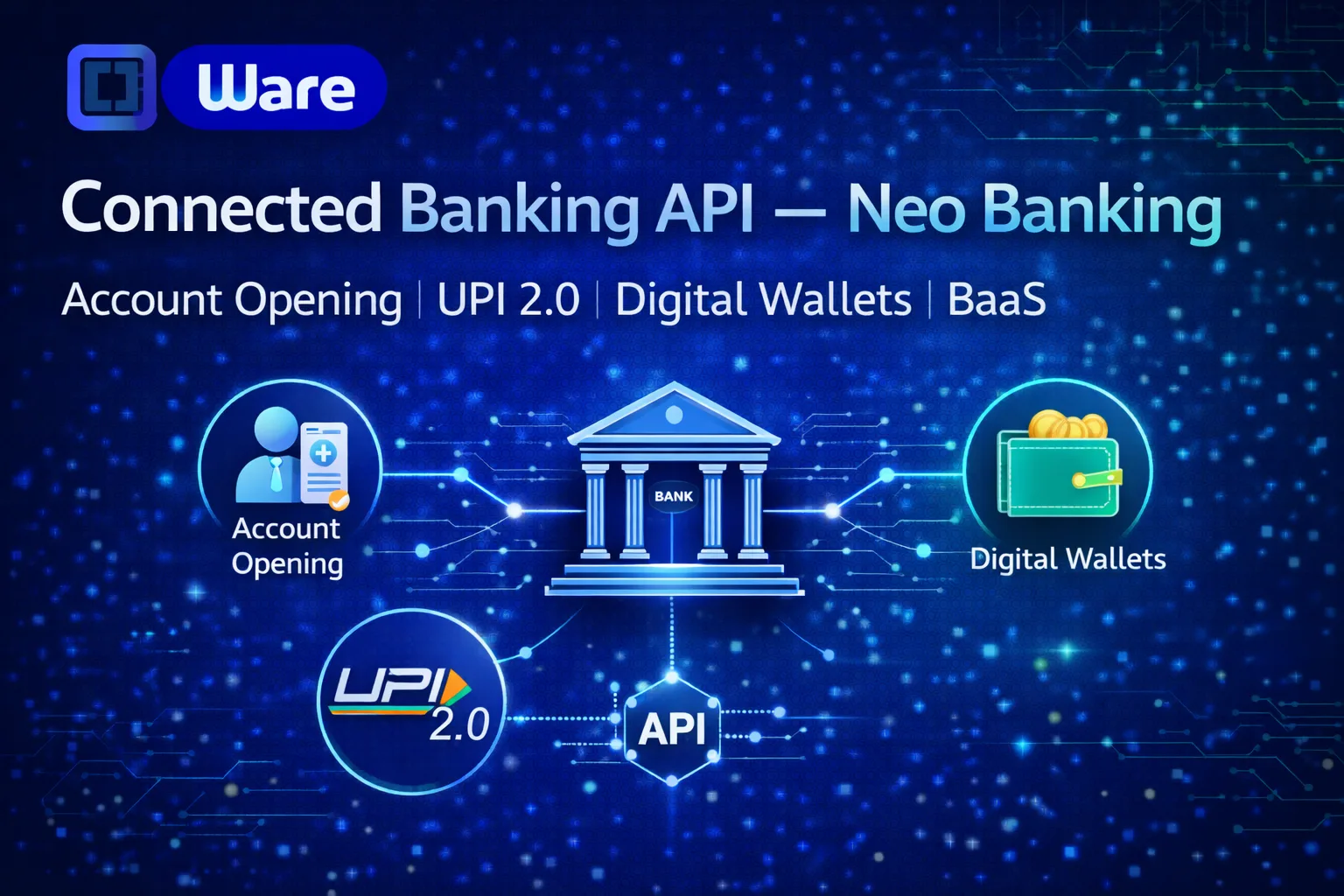
What is Connected Banking Payout?
Connected Banking Payout is a next-generation payment disbursement system that directly connects your business to multiple banks through a single API. Unlike traditional payout methods that rely on intermediary payment aggregators, connected banking establishes a direct pipeline between your platform and the banking network, enabling faster, cheaper, and more reliable fund transfers.
At nxt Banking, our Connected Banking Payout API leverages AI-powered smart routing to automatically select the optimal bank channel for each transaction — whether it is IMPS, NEFT, RTGS, or UPI — ensuring maximum success rates and minimal latency.
How Connected Banking Payout API Works
The architecture behind connected banking is fundamentally different from conventional payment gateways. Here is the complete flow:
- API Request: Your application sends a payout request to the NxtBanking API with beneficiary details, amount, and preferred mode.
- Smart Routing Engine: Our AI engine evaluates real-time bank availability, transaction limits, and success rates across 150+ bank connections.
- Direct Bank Processing: The transaction is routed directly to the selected bank — no intermediary aggregator delays.
- Instant Confirmation: Real-time webhook callback confirms the transaction status within seconds.
- Auto-Reconciliation: Our system automatically reconciles every transaction with your ledger.
Key Features of NxtBanking Connected Banking Payout
- 150+ Bank Integrations: Direct connectivity with all major Indian banks including SBI, HDFC, ICICI, Axis, and more.
- Multi-Mode Support: IMPS, NEFT, RTGS, and UPI payouts through a single API endpoint.
- AI-Powered Smart Routing: Machine learning algorithms that reduce transaction failures by 40%.
- Virtual Account Payouts: Unique virtual accounts for each vendor/employee with automatic tracking.
- Bulk Processing: Process 10,000+ payouts in a single batch with parallel execution.
- Real-Time Webhooks: Instant status callbacks for every transaction.
- 99.99% Uptime SLA: Enterprise-grade reliability with redundant infrastructure.
Benefits for Enterprises
1. Reduced Transaction Costs
By eliminating intermediary payment aggregators, connected banking reduces per-transaction costs by up to 60%. Direct bank connections mean fewer processing fees and no hidden charges.
2. Faster Settlement
Traditional payout systems can take T+1 or T+2 days for settlement. With connected banking, IMPS payouts settle in real-time (under 30 seconds), and even NEFT processes within 30 minutes.
3. Higher Success Rates
Our smart routing engine maintains a 99.5% success rate by automatically failovering to alternative bank channels when a primary route experiences issues.
4. Complete Visibility
Real-time dashboards, transaction tracking, and automated reconciliation give your finance team complete visibility into every rupee disbursed.
Integration Guide: Step-by-Step
Integrating the Connected Banking Payout API from nxt Banking takes as little as 2 hours with our developer-friendly SDKs.
Step 1: Sign Up & Get API Keys
Create your account on the NxtBanking API Marketplace and generate your production API credentials.
Step 2: Configure Webhooks
Set up your callback URL in the dashboard to receive real-time transaction status updates.
Step 3: Add Beneficiaries
Register beneficiary bank accounts via the API or dashboard. All accounts are verified automatically via penny drop verification.
Step 4: Initiate Payouts
Send payout requests with amount, beneficiary ID, and preferred transfer mode. The smart routing engine handles the rest.
Step 5: Monitor & Reconcile
Use the real-time dashboard or API to track every payout and download reconciliation reports.
Use Cases
- Salary Disbursement: Bulk salary payouts to 10,000+ employees in minutes.
- Vendor Payments: Automated vendor settlements with virtual account tracking.
- Insurance Claims: Instant claim disbursements to policyholder bank accounts.
- Lending Platforms: Real-time loan disbursement to borrower accounts.
- E-commerce Refunds: Instant refund processing to customer bank accounts.
- Gig Economy Payouts: Daily or weekly automated payouts to delivery partners and freelancers.
Frequently Asked Questions
What is connected banking payout?
Connected banking payout is a direct bank integration system that enables businesses to send money directly through bank networks without intermediary aggregators, resulting in faster and cheaper transactions.
How is connected banking different from payment gateway payouts?
Payment gateways use intermediary layers that add latency and cost. Connected banking establishes direct bank-to-bank connections, reducing fees by up to 60% and settlement time to near-instant.
What transfer modes are supported?
NxtBanking Connected Banking Payout supports IMPS, NEFT, RTGS, and UPI transfers through a single unified API.
Is connected banking payout secure?
Yes. All transactions are encrypted with bank-grade TLS 1.3 encryption, and the platform is PCI-DSS compliant with multi-factor authentication for all API access.
How quickly can I integrate the API?
Most businesses complete integration within 2–4 hours using our RESTful API and pre-built SDKs for Python, Node.js, Java, and PHP.
Get Started With Connected Banking Payout →
People Also Ask
What is the difference between connected banking and normal banking?
Connected banking uses direct API integration with bank core systems, eliminating intermediaries. Normal banking relies on payment aggregators as middlemen. Connected banking offers lower costs (₹1-3 vs 1-2%), faster settlement, and higher success rates.
Which banks support connected banking in India?
Major banks including ICICI, HDFC, Axis, Yes Bank, RBL, and IndusInd offer connected banking APIs. NxtBanking provides pre-integrated access to multiple banks through a single API endpoint.
Related Resources
- What is Connected Banking? Complete Guide for Indian Enterprises
- Connected Banking vs Traditional Payout: Why Enterprises Are Switching
📚 Connected Banking Content Hub
- Connected Banking vs Traditional Payout: Why Enterprises Are Switching
- What is Connected Banking? Complete Guide for Indian Enterprises
Code Samples & Implementation Reference
This section gives you copy-pasteable code for the four operations every fintech engineer hits on day one: getting an OAuth token, fetching the balance of your settlement account, pushing a payout, and reacting to the webhook that confirms settlement. All examples hit the sandbox base URL https://sandbox.nxtbanking.com/v1; switch to https://api.nxtbanking.com/v1 when you go live.
1. Authentication — OAuth 2.0 client credentials
Tokens are short-lived (1 hour). Cache them; don’t request a fresh token on every API call.
curl -X POST https://sandbox.nxtbanking.com/v1/oauth/token \
  -H "Content-Type: application/x-www-form-urlencoded" \
  -d "grant_type=client_credentials" \
  -d "client_id=$NXTB_CLIENT_ID" \
  -d "client_secret=$NXTB_CLIENT_SECRET" \
  -d "scope=payouts:write balance:read"
// Node.js (axios)
import axios from "axios";

async function getToken() {
  const res = await axios.post(
    "https://sandbox.nxtbanking.com/v1/oauth/token",
    new URLSearchParams({
      grant_type: "client_credentials",
      client_id: process.env.NXTB_CLIENT_ID,
      client_secret: process.env.NXTB_CLIENT_SECRET,
      scope: "payouts:write balance:read",
    })
  );
  return res.data.access_token;
}
# Python (requests)
import os, requests

def get_token():
    r = requests.post(
        "https://sandbox.nxtbanking.com/v1/oauth/token",
        data={
            "grant_type": "client_credentials",
            "client_id": os.environ["NXTB_CLIENT_ID"],
            "client_secret": os.environ["NXTB_CLIENT_SECRET"],
            "scope": "payouts:write balance:read",
        },
        timeout=10,
    )
    r.raise_for_status()
    return r.json()["access_token"]
2. Check balance before payout
Always verify you have enough float before firing a payout. Balance lookups are free and cached server-side for 2 seconds.
curl -X GET https://sandbox.nxtbanking.com/v1/accounts/settlement/balance \
  -H "Authorization: Bearer $ACCESS_TOKEN"
// Response
{
  "account_id": "NXTB_SETTLE_001",
  "available_balance": 1824500.00,
  "ledger_balance": 1824500.00,
  "currency": "INR",
  "as_of": "2026-04-22T17:31:02Z"
}
3. Initiate a payout
The reference_id field MUST be unique per payout — we use it for idempotency. Send the same reference twice within 24 hours and the second call returns the original payout (no double-debit).
// Node.js
async function pushPayout(token, beneficiary, amount) {
  return axios.post(
    "https://sandbox.nxtbanking.com/v1/payouts",
    {
      reference_id: `PO_${Date.now()}_${beneficiary.id}`,
      amount: amount,
      currency: "INR",
      mode: "IMPS", // IMPS | NEFT | RTGS | UPI
      beneficiary: {
        name: beneficiary.name,
        ifsc: beneficiary.ifsc,
        account_number: beneficiary.account_number,
      },
      purpose: "vendor_payment",
      webhook_url: "https://yourapp.com/webhooks/nxtb/payout",
    },
    { headers: { Authorization: `Bearer ${token}` } }
  );
}

// Synchronous response (terminal status returned async via webhook)
{
  "payout_id": "po_9x2m7k8f",
  "reference_id": "PO_1745334662_BEN_42",
  "status": "PROCESSING",
  "mode": "IMPS",
  "amount": 2500.00,
  "fee": 4.50,
  "gst": 0.81,
  "created_at": "2026-04-22T17:31:02Z",
  "estimated_completion": "2026-04-22T17:31:22Z"
}
4. Handle the webhook (signed payload)
Every webhook carries an X-NxtB-Signature header — an HMAC-SHA256 of the raw body keyed by your webhook secret. Verify the signature before trusting any field. Reject any payload that fails verification with HTTP 401.
// Node.js (Express)
import crypto from "crypto";

app.post("/webhooks/nxtb/payout", express.raw({ type: "application/json" }),
  (req, res) => {
    const sig = req.header("X-NxtB-Signature");
    const expected = crypto
      .createHmac("sha256", process.env.NXTB_WEBHOOK_SECRET)
      .update(req.body) // raw Buffer, not parsed JSON
      .digest("hex");

    if (!sig || !crypto.timingSafeEqual(Buffer.from(sig), Buffer.from(expected))) {
      return res.status(401).send("Invalid signature");
    }

    const event = JSON.parse(req.body.toString());
    switch (event.status) {
      case "SUCCESS": handlePayoutSuccess(event); break;
      case "FAILED": handlePayoutFailed(event); break;
      case "REVERSED": handlePayoutReversed(event); break;
    }
    res.sendStatus(200); // always 200 within 5s or we retry
  }
);
Error handling & retry strategy
HTTP response codes follow standard REST conventions. The most common statuses you'll see in production:
| HTTP | Meaning | Retry? |
|---|---|---|
| 200 / 201 | Success | — |
| 400 | Validation error (bad IFSC, amount too high, etc.) | No — fix the request |
| 401 | Token expired or invalid | Refresh token, retry once |
| 409 | Duplicate reference_id | No — look up the original payout |
| 422 | Business rule failed (insufficient balance, beneficiary blocked) | No |
| 429 | Rate limit exceeded | Yes — back off per Retry-After header |
| 500 / 502 / 503 | Transient upstream error | Yes — exponential backoff, max 3 retries |
| 504Gateway timeoutDo NOT retry on POST /payouts — check status via GET first |
Critical rule for payouts: never retry a POST /v1/payouts on a 5xx or network timeout until you’ve called GET /v1/payouts?reference_id=YOUR_REF to confirm the original request didn’t already create a payout. Because we’re idempotent on reference_id, sending the same reference again is safe — but only if the original request actually failed before reaching us.
Testing in sandbox
The sandbox mirrors production behaviour but never actually moves money. Use these special IFSC codes to simulate scenarios:
- NXTB0SUCCESS — immediate SUCCESS webhook within 3 seconds.
- NXTB0DELAY00 — SUCCESS webhook after 45 seconds (test your job queue).
- NXTB0FAILED0 — FAILED webhook with reason BENEFICIARY_ACCOUNT_INACTIVE.
- NXTB0REVERSE — SUCCESS followed by REVERSED webhook 2 minutes later.
- NXTB0RATELMT — returns 429 to exercise your retry logic.
For production readiness checklist, see our Integrate Payout API into a Fintech App guide and the Multi-Bank Payout System Architecture article.
Monitoring & observability
Instrument these four signals from day one — they’ll catch 95% of production issues before your ops team hears about them:
- Latency p50 / p95 / p99 on POST /v1/payouts — alert if p95 > 1500 ms.
- Success-rate % by mode (IMPS / NEFT / RTGS / UPI) over a rolling 5-minute window — alert if any mode drops below 95%.
- Webhook lag = time from created_at to webhook receipt — alert if p95 > 60 seconds.
- Balance low-water-mark — alert when settlement balance drops below 2× your daily average outflow.