Instant Payout API: Webhooks, Status Codes, and Reconciliation
Instant payouts are only as good as your status pipeline. Production teams should design for duplicate callbacks, delayed reversals, and partial batch failures. If you are integrating an instant payout API, treat webhooks as the source of truth after your initiation response.
Idempotency
Always send idempotency keys for payout creation so retries do not double-pay.
Reconciliation
Match bank settlement files with internal ledger daily; APIs reduce but do not eliminate variance investigations.
Related: Best payout API · BBPS API · AEPS API · Mobile recharge API · Request demo
Instant Payout API: Webhooks & Reconciliation Guide
Building a reliable payout system requires more than just initiating bank transfers. You need real-time updates via webhooks and accurate reconciliation to keep your financial records clean. This guide covers both in detail.
What Are Payout Webhooks?
Webhooks are HTTP callbacks that NxtBanking sends to your server whenever a payout transaction changes status. Rather than polling our API every few seconds, your system simply listens for webhook events — making your integration efficient and real-time.
Common Payout Webhook Events
payout.initiated— Transaction submitted to banking networkpayout.processing— Transaction being processed by the bankpayout.success— Money credited to beneficiary accountpayout.failed— Transaction failed (includes error code and reason)payout.reversed— Funds returned to sender wallet
How to Handle Webhooks Securely
- Verify signature: NxtBanking signs every webhook with HMAC-SHA256. Always verify the signature before processing.
- Idempotency: Use the reference ID to avoid processing the same event twice.
- Return 200 quickly: Acknowledge within 5 seconds and process asynchronously.
- Retry handling: If your server returns non-200, NxtBanking retries 3 times with exponential backoff.
Payout Reconciliation — Daily Process
Reconciliation ensures that your internal records match NxtBanking’s transaction records and your bank statement. Here’s the recommended daily reconciliation flow:
- Step 1: Download daily transaction report from NxtBanking dashboard (CSV or API)
- Step 2: Match each transaction against your internal database using the reference ID
- Step 3: Flag any discrepancies (pending, failed, or reversed transactions)
- Step 4: Reconcile closing wallet balance against NxtBanking ledger
- Step 5: Raise disputes for unresolved mismatches within 24 hours
Reconciliation API Endpoints
NxtBanking provides dedicated reconciliation API endpoints:
GET /transactions?date=YYYY-MM-DD— Full transaction list for a dateGET /transaction/{ref_id}/status— Status of a specific transactionGET /wallet/balance— Real-time wallet balanceGET /settlements— Settlement history and amounts
About This Topic
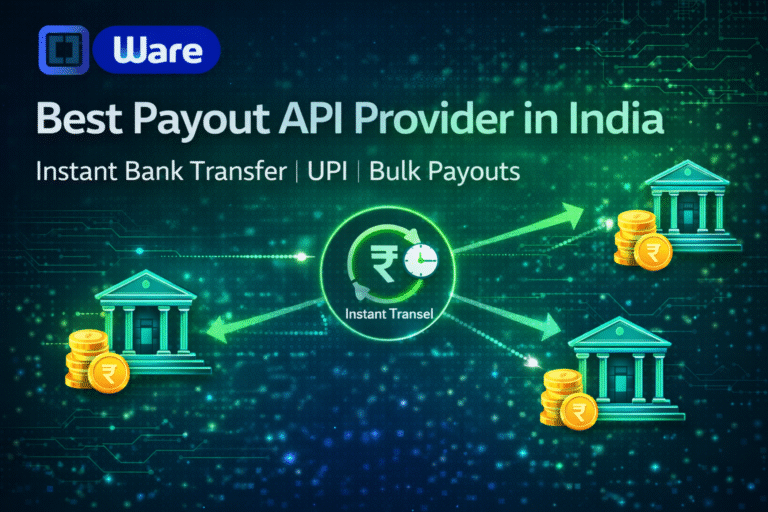
Payout APIs automate fund disbursements from a business's bank account to any number of recipients via IMPS, NEFT, RTGS, or UPI. NxtBanking's connected-banking Payout API routes each transaction across multiple partner banks for automatic failover, achieving 99%+ success rates. Enterprise clients use it for salary disbursements, vendor payments, insurance claims, loan disbursals, and marketplace payouts — all triggered via REST API with instant webhook callbacks.
Quick Answers
What payment rails are used for payout API transactions?
Payout APIs in India route transactions over IMPS (real-time, up to ₹5 lakh), NEFT (batch-based, any amount), RTGS (real-time, ₹2 lakh+), and UPI (real-time, up to ₹2 lakh for P2M). The optimal rail is selected based on amount, time sensitivity, and bank availability.
What is the typical payout API success rate?
Enterprise-grade payout APIs like NxtBanking's achieve 99%+ transaction success rates through multi-bank connected routing with automatic failover. Single-bank integrations typically achieve 90–95% success due to periodic bank downtime and maintenance windows.
Is NxtBanking RBI-compliant for payment APIs?
Yes. NxtBanking operates through RBI-licensed partner banks for all payment services (IMPS, NEFT, RTGS, UPI) and is NPCI-certified for BBPS, AEPS, and UPI flows. All APIs follow RBI's Master Directions on payment aggregators, KYC, and PMLA obligations. We maintain audit logs, data localisation, and consent frameworks compliant with the DPDP Act 2023.
How does NxtBanking handle API downtime and failover?
NxtBanking uses a connected-banking architecture that links a single API credential to multiple RBI-licensed partner banks. When one bank's rails experience degradation or maintenance, the API automatically routes to the next available bank — with no code change required on the client side. This multi-bank failover is what delivers 99%+ transaction success rates and 99.9% API uptime SLA for enterprise clients.
What does it cost to integrate NxtBanking APIs?
NxtBanking offers pay-as-you-go pricing with no setup fees and no minimum commitment for most APIs. Typical pricing: IMPS/UPI payout ₹3–₹8 per transaction, NEFT ₹1–₹3, BBPS bill payment ₹0.50–₹3, AEPS cash withdrawal ₹2–₹5. Enterprise clients on committed volumes negotiate flat-rate pricing. Sandbox access is free and unlimited. Contact sales for a custom quote based on your expected transaction volume.
Key Terms
- API
- Application Programming Interface — a structured software interface that lets applications communicate with each other over the internet using defined endpoints, authentication, and data formats.
NxtBanking is India's AI-powered fintech API platform trusted by hundreds of fintechs, BC networks, NBFCs, and enterprise companies. Our unified API marketplace covers payout (IMPS, NEFT, RTGS, UPI), BBPS bill payment with 20,000+ billers, AEPS biometric banking, KYC and identity verification (Aadhaar, PAN, Bank, Driving Licence, Voter ID, RC), UPI collection and QR codes, domestic money transfer (DMT), mobile and DTH recharge, Micro-ATM, and travel APIs — all under one master agreement, one set of credentials, and one consolidated monthly invoice.
Every NxtBanking API is backed by a 99.9% uptime SLA, real-time webhook delivery, a full-featured sandbox environment with simulated error scenarios, comprehensive API documentation with Postman collections and code samples in multiple languages, and dedicated technical onboarding support. Production go-live for most APIs is achievable within 7–15 business days after KYC and compliance review. For enterprise clients requiring custom SLAs, dedicated infrastructure, or white-label platform builds, NxtBanking offers tailored commercial terms with no minimum volume commitment at the pilot stage.