AEPS API Provider Comparison: Best AEPS Providers in India (2026)
his AEPS API provider comparison will help fintech businesses, retailers, startups, and payment service providers choose the right AEPS partner in India. Selecting the right provider is critical because transaction success rate, settlement speed, API stability, and technical support directly affect business performance.
India’s Aadhaar Enabled Payment System (AEPS) ecosystem is growing rapidly due to financial inclusion and digital banking adoption. Multiple companies now offer AEPS APIs with different pricing, infrastructure quality, and features. Choosing the best AEPS API provider requires careful comparison.
What is an AEPS API Provider
An AEPS API provider offers Aadhaar-based banking APIs that allow businesses to provide services such as:
- Cash withdrawal
- Balance enquiry
- Mini statement
- Aadhaar authentication
- Aadhaar Pay
These APIs connect fintech platforms with banking infrastructure and NPCI-supported systems.
NPCI Official Website
RBI Official Website
Why AEPS API Provider Comparison is Important
A proper AEPS API provider comparison helps businesses evaluate:
- Transaction success rate
- Commission structure
- API uptime
- Technical support
- Settlement speed
- Security standards
- Multi-bank connectivity
The wrong provider can lead to transaction failures, delayed settlements, customer complaints, and revenue loss.
Top AEPS API Providers in India
NxtBanking
NxtBanking provides fintech APIs including AEPS, BBPS, DMT, payout, and recharge services. It focuses on scalable APIs, fintech integrations, and multi-service digital banking infrastructure.
Features:
- Developer-friendly APIs
- Multi-service integration
- White-label support
- Fintech-focused infrastructure
NxtBanking AEPS API
NxtBanking Contact Page
PayNearby
PayNearby is one of the most recognized AEPS providers in India with strong rural penetration and a large retailer network. It offers AEPS along with bill payments, insurance, and recharge services.
Strengths:
- Large retailer network
- Strong rural coverage
- Multiple fintech services
Limitations:
- Support delays during peak load reported by some users.
Spice Money
Spice Money is widely used for AEPS and rural fintech services. It supports micro ATM and Aadhaar-based banking services.
Strengths:
- Strong brand recognition
- Multiple financial services
- Retail-focused ecosystem
Limitations:
- Some reports of occasional technical issues.
Fino Payments Bank
Fino Payments Bank is known for secure transactions and strong banking infrastructure. It is commonly used in rural and semi-urban banking services.
Strengths:
- Strong banking trust
- Secure transactions
- Reliable settlements
Limitations:
- Premium pricing in some cases.
EKO India
EKO India provides AEPS and DMT APIs with developer-focused integration support. It is popular among fintech startups and API aggregators.
Strengths:
- Good API documentation
- Fintech-friendly APIs
- Easy integration
Airtel Payments Bank
Airtel Payments Bank offers AEPS through its digital banking infrastructure and telecom ecosystem.
Strengths:
- Large network reach
- Strong digital ecosystem
- Trusted brand
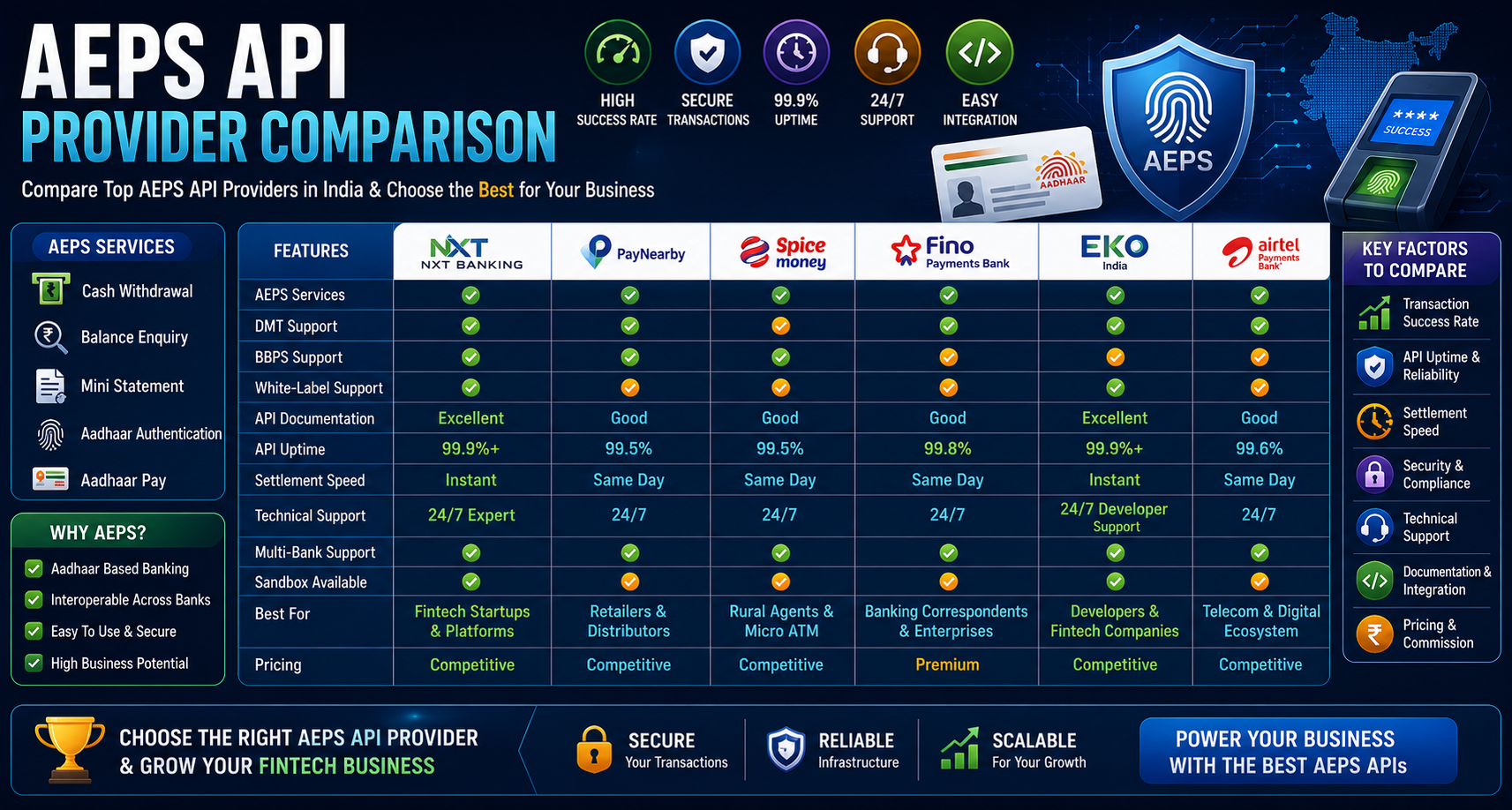
AEPS API Provider Comparison Table
| Feature | NxtBanking | PayNearby | Spice Money | Fino Payments Bank | EKO India |
|---|---|---|---|---|---|
| AEPS Services | Yes | Yes | Yes | Yes | Yes |
| DMT Support | Yes | Yes | Limited | Yes | Yes |
| BBPS Support | Yes | Yes | Yes | Limited | Limited |
| White-Label Support | Yes | Limited | Limited | Limited | Yes |
| API Documentation | Strong | Moderate | Moderate | Moderate | Strong |
| Rural Reach | Growing | Very Strong | Strong | Strong | Moderate |
| Technical Support | Fintech-focused | Good | Good | Banking-focused | Developer-focused |
| Multi-Service APIs | Yes | Yes | Yes | Limited | Yes |
| Sandbox Environment | Yes | Limited | Limited | Limited | Yes |
| Best For | Fintech startups | Retailers | Rural agents | Secure banking | Developers |
Key Factors to Compare Before Choosing
Transaction Success Rate
Higher success rate means fewer failed transactions and better customer trust.
Settlement Speed
Fast settlements improve cash flow and retailer confidence.
API Uptime
High uptime ensures uninterrupted services.
Documentation Quality
Good documentation reduces integration complexity.
Security Standards
Choose providers with:
- HTTPS encryption
- Secure authentication
- NPCI compliance
- Monitoring systems
Technical Support
Strong support is critical during integration and production issues.
Which AEPS API Provider is Best
Best for Fintech Startups
NxtBanking and EKO India are suitable due to developer-focused APIs and integration flexibility.
Best for Rural Retail Networks
PayNearby and Spice Money have strong rural reach and retailer penetration.
Best for Secure Banking Infrastructure
Fino Payments Bank is preferred for secure banking-oriented operations.
Common Challenges While Selecting AEPS Providers
Poor Documentation
Bad documentation slows integration.
Frequent Downtime
Unstable APIs reduce transaction success.
Weak Support
Slow support affects operations and customer trust.
Hidden Pricing
Unexpected charges reduce profitability.
Best Practices Before AEPS API Integration
Test Sandbox Environment
Always test APIs before production deployment.
Compare Settlement Process
Understand payout cycles and reconciliation methods.
Check Device Compatibility
Ensure biometric devices are supported.
Validate Multi-Bank Support
Broader bank coverage improves customer reach.
Future of AEPS APIs in India
The future of AEPS APIs includes:
- Better fintech integrations
- Faster biometric authentication
- AI-powered fraud detection
- Real-time settlements
- Embedded banking solutions
India’s AEPS ecosystem will continue growing with financial inclusion and digital banking expansion.
Conclusion
This AEPS API provider comparison shows that every provider has different strengths. Some focus on retailer networks, while others prioritize fintech integrations, security, or scalability.
Businesses should evaluate transaction success rate, technical support, documentation quality, security, settlement speed, and scalability before choosing an AEPS partner. The right provider can help fintech businesses grow faster, improve customer trust, and build reliable digital banking services.
About This Topic
The NxtBanking blog is India's authoritative technical resource for fintech API integration — covering Payout API, BBPS, AEPS, UPI, KYC, DMT, recharge APIs, and enterprise payment infrastructure. Every article is written by practitioners who have built and scaled payment systems processing millions of transactions, combining technical accuracy with real-world implementation guidance for developers, product teams, and fintech founders.
Quick Answers
What is AEPS and how does it work?
AEPS (Aadhaar Enabled Payment System) is an NPCI-operated banking service that authenticates customers using their Aadhaar number and biometric fingerprint, allowing cash withdrawal, balance enquiry, and mini statement at Business Correspondent points without a debit card or PIN.
Who can use AEPS?
Any Indian resident with an Aadhaar-linked bank account can use AEPS at a registered BC or Micro-ATM outlet. It is specifically designed for rural and unbanked populations who lack access to physical bank branches or ATMs.
Is NxtBanking RBI-compliant for payment APIs?
Yes. NxtBanking operates through RBI-licensed partner banks for all payment services (IMPS, NEFT, RTGS, UPI) and is NPCI-certified for BBPS, AEPS, and UPI flows. All APIs follow RBI's Master Directions on payment aggregators, KYC, and PMLA obligations. We maintain audit logs, data localisation, and consent frameworks compliant with the DPDP Act 2023.
How does NxtBanking handle API downtime and failover?
NxtBanking uses a connected-banking architecture that links a single API credential to multiple RBI-licensed partner banks. When one bank's rails experience degradation or maintenance, the API automatically routes to the next available bank — with no code change required on the client side. This multi-bank failover is what delivers 99%+ transaction success rates and 99.9% API uptime SLA for enterprise clients.
What does it cost to integrate NxtBanking APIs?
NxtBanking offers pay-as-you-go pricing with no setup fees and no minimum commitment for most APIs. Typical pricing: IMPS/UPI payout ₹3–₹8 per transaction, NEFT ₹1–₹3, BBPS bill payment ₹0.50–₹3, AEPS cash withdrawal ₹2–₹5. Enterprise clients on committed volumes negotiate flat-rate pricing. Sandbox access is free and unlimited. Contact sales for a custom quote based on your expected transaction volume.
Key Terms
- AEPS
- Aadhaar Enabled Payment System — a bank-agnostic cash withdrawal and balance enquiry service authenticated via Aadhaar biometrics, operated under NPCI.
- API
- Application Programming Interface — a structured software interface that lets applications communicate with each other over the internet using defined endpoints, authentication, and data formats.
NxtBanking is India's AI-powered fintech API platform trusted by hundreds of fintechs, BC networks, NBFCs, and enterprise companies. Our unified API marketplace covers payout (IMPS, NEFT, RTGS, UPI), BBPS bill payment with 20,000+ billers, AEPS biometric banking, KYC and identity verification (Aadhaar, PAN, Bank, Driving Licence, Voter ID, RC), UPI collection and QR codes, domestic money transfer (DMT), mobile and DTH recharge, Micro-ATM, and travel APIs — all under one master agreement, one set of credentials, and one consolidated monthly invoice.
Every NxtBanking API is backed by a 99.9% uptime SLA, real-time webhook delivery, a full-featured sandbox environment with simulated error scenarios, comprehensive API documentation with Postman collections and code samples in multiple languages, and dedicated technical onboarding support. Production go-live for most APIs is achievable within 7–15 business days after KYC and compliance review. For enterprise clients requiring custom SLAs, dedicated infrastructure, or white-label platform builds, NxtBanking offers tailored commercial terms with no minimum volume commitment at the pilot stage.