
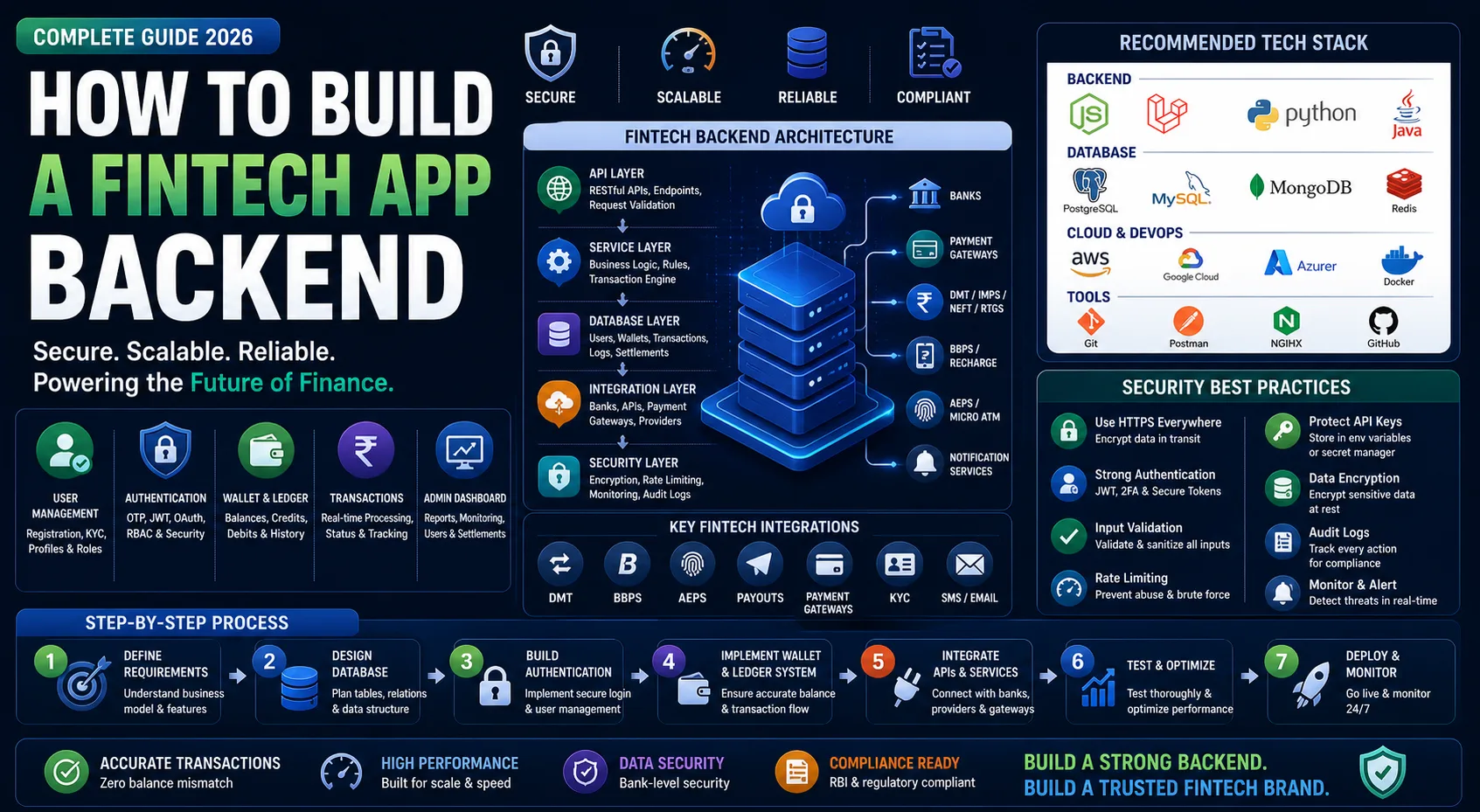
Learning how to build a fintech app backend is essential for creating secure, scalable, and reliable financial applications. A fintech backend handles sensitive user data, transactions, authentication, API integrations, wallet systems, and reporting.
In India, fintech apps are growing fast because of digital payments, API-based banking, and financial inclusion. A strong backend ensures your app can process transactions safely and perform well as users increase.
What is a Fintech App Backend
A fintech app backend is the server-side system that powers the application. It manages business logic, user accounts, databases, APIs, payment requests, transaction records, security, and admin operations.
Core Features of a Fintech Backend
User Management
The backend should manage user registration, login, KYC status, profile updates, and account security.
Authentication and Authorization
Use secure login systems such as OTP, password authentication, OAuth, JWT, and role-based access control.
Wallet and Ledger System
A fintech backend should maintain accurate wallet balances, debits, credits, refunds, and transaction history.
Payment and API Integrations
Integrate services such as DMT, BBPS, AEPS, payout APIs, and payment gateway APIs.
API Marketplace
API Marketplace
API Marketplace
Transaction Management
Every transaction should have a unique reference ID, status tracking, logs, and reconciliation support.
Admin Dashboard
Admins should be able to monitor users, transactions, settlements, commissions, reports, and support tickets.
Recommended Backend Architecture
API Layer
This layer receives requests from mobile apps, websites, or partner systems.
Service Layer
This layer handles business logic such as user verification, transaction processing, wallet updates, and commission calculation.
Database Layer
This stores users, transactions, wallet entries, logs, and reports.
Integration Layer
This connects your platform with banks, API providers, payment gateways, and notification services.
Security Layer
This protects your backend using authentication, encryption, rate limiting, and monitoring.
Best Technology Stack
Backend Languages
Common choices include:
- Node.js
- Laravel
- Python
- Java
- Go
Databases
Use reliable databases such as:
- PostgreSQL
- MySQL
- MongoDB
- Redis for caching
Cloud Hosting
Use scalable infrastructure such as:
- AWS
- Google Cloud
- Azure
- DigitalOcean
Step-by-Step Process to Build a Fintech App Backend
Step 1: Define the Business Model
Decide whether your app will support wallets, payments, bill payments, money transfer, lending, or multiple fintech services.
Step 2: Design the Database
Create tables for:
- Users
- KYC records
- Wallets
- Transactions
- Beneficiaries
- API logs
- Settlements
- Commissions
Step 3: Build Authentication
Add secure authentication with OTP, JWT, password hashing, token expiry, and session control.
Step 4: Create Wallet and Ledger Logic
Use double-entry ledger logic where every credit and debit is properly recorded. This prevents balance mismatch.
Step 5: Integrate Fintech APIs
Connect APIs for services like DMT, BBPS, AEPS, payouts, recharge, and payment gateways.
Step 6: Add Transaction Status Tracking
Support statuses such as:
- Success
- Failed
- Pending
- Reversed
- Refunded
Step 7: Build Reconciliation System
Match internal transaction records with provider reports to identify mismatches.
Step 8: Add Security Controls
Use HTTPS, encryption, input validation, API rate limiting, IP whitelisting, and audit logs.
owasp.org
Reserve Bank of India
Step 9: Create Admin Panel APIs
Build APIs for dashboard reporting, user management, transaction search, and support operations.
Step 10: Test Before Launch
Test authentication, transactions, callbacks, refunds, settlement, load handling, and security.
Security Best Practices
Protect API Keys
Store credentials in environment variables or a secrets manager.
Use Strong Encryption
Encrypt sensitive data in transit and at rest.
Validate Every Request
Validate user inputs, transaction amounts, account numbers, and request headers.
Add Rate Limiting
Prevent abuse by limiting request frequency.
Monitor Suspicious Activity
Track failed login attempts, unusual transaction patterns, and high-risk behavior.
Common Backend Challenges
Transaction Mismatch
Incorrect wallet updates can create balance issues.
API Downtime
Provider downtime may affect services.
Callback Failure
Webhook failures can cause wrong transaction status.
Security Risk
Weak authentication can expose financial data.
Scalability Issues
Poor architecture can fail under high traffic.
Conclusion
To build a fintech app backend, you need secure architecture, reliable APIs, proper database design, transaction tracking, and strong monitoring. A fintech backend must be accurate, scalable, and compliant because it handles sensitive financial operations.
With the right planning and technology, businesses can build powerful fintech platforms that support payments, money transfers, bill payments, and other digital banking services.