IMPS vs NEFT vs RTGS vs DMT: Full Comparison
Understanding the difference between IMPS vs NEFT vs RTGS vs DMT is essential for businesses and individuals dealing with digital payments.
With the rapid growth of fintech in India, multiple money transfer methods are available, each with its own advantages, limitations, and use cases.
This guide provides a complete comparison of IMPS vs NEFT vs RTGS vs DMT to help you choose the right transfer method.
What is IMPS
IMPS (Immediate Payment Service) is a real-time interbank electronic fund transfer system.
- Instant transfer
- Available 24/7
- Suitable for small to medium transactions
It is managed by National Payments Corporation of India.
Outbound Link:
https://www.npci.org.in/what-we-do/imps/product-overview
What is NEFT
NEFT (National Electronic Funds Transfer) is a bank-to-bank transfer system that works in batches.
- Available 24/7
- Slight delay due to batch processing
- Suitable for general transfers
https://www.rbi.org.in/Scripts/FAQView.aspx?Id=60
What is RTGS
RTGS (Real-Time Gross Settlement) is used for high-value transactions.
- Real-time processing
- High minimum amount
- Used for large transfers
Outbound Link:
https://www.rbi.org.in/Scripts/RTGS.aspx
What is DMT
DMT (Domestic Money Transfer) is an API-based system that allows businesses to offer money transfer services using IMPS, NEFT, and RTGS.
- Used by fintech platforms
- Supports agent-based transfers
- Enables instant customer services
https://nxtbanking.com/dmt-api
Key Differences: IMPS vs NEFT vs RTGS vs DMT
Speed
- IMPS: Instant
- NEFT: Batch-based (slight delay)
- RTGS: Real-time
- DMT: Depends on IMPS/NEFT/RTGS
Availability
- IMPS: 24/7
- NEFT: 24/7 (processed in batches)
- RTGS: 24/7 (for most banks)
- DMT: 24/7 (depends on API provider)
Transaction Limit
- IMPS: Up to ₹5 lakh (varies by bank)
- NEFT: No minimum or maximum limit
- RTGS: Minimum ₹2 lakh
- DMT: Depends on provider and KYC
Use Case
- IMPS: Instant transfers
- NEFT: Regular payments
- RTGS: Large transactions
- DMT: Business/retail money transfer
Users
- IMPS: Individuals and businesses
- NEFT: Individuals and businesses
- RTGS: Businesses and high-value users
- DMT: Fintech platforms, agents, retailers
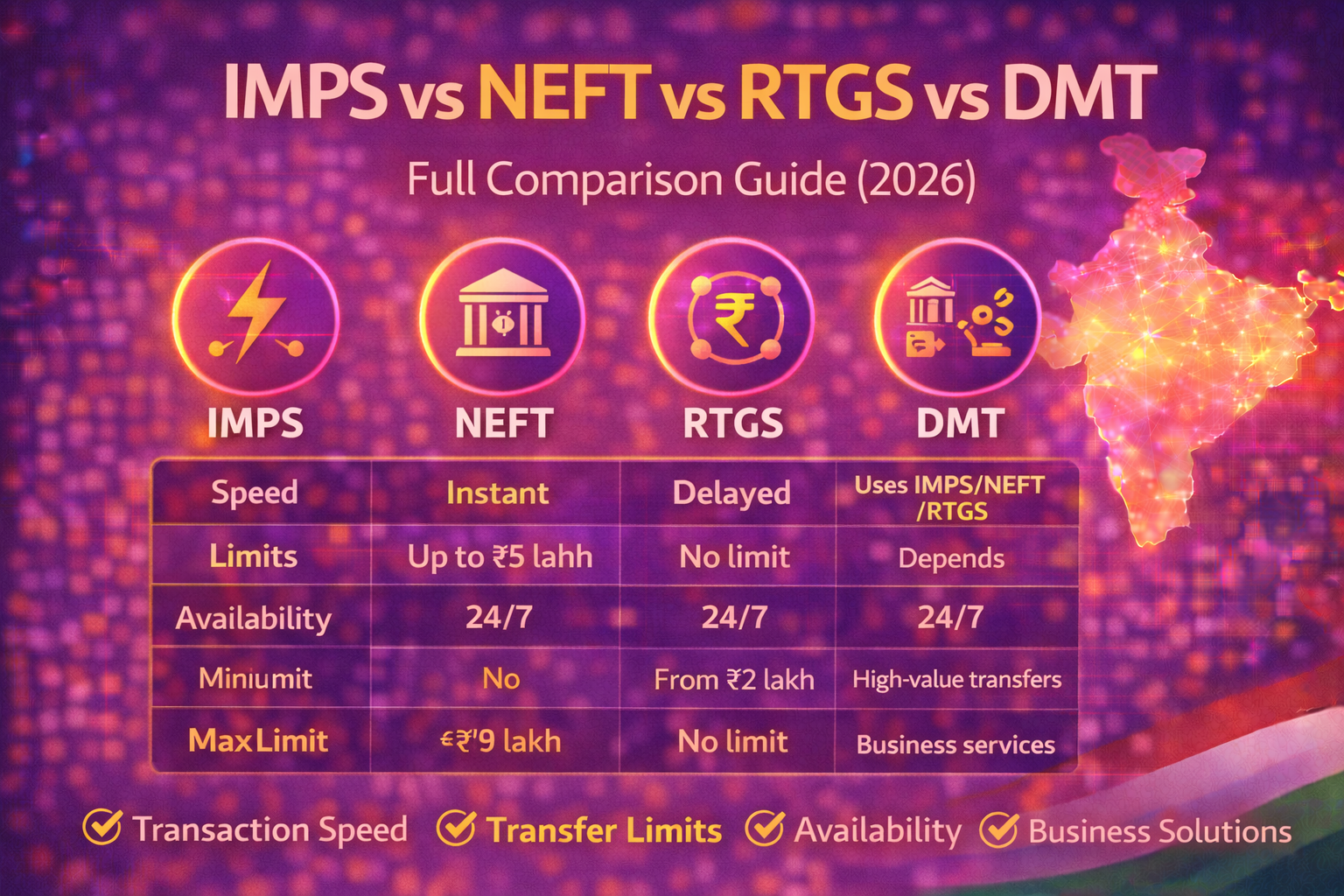
Detailed Comparison Table
| Feature | IMPS | NEFT | RTGS | DMT |
|---|---|---|---|---|
| Speed | Instant | Delayed (batch) | Real-time | Depends on method |
| Availability | 24/7 | 24/7 | 24/7 | 24/7 |
| Min Limit | No | No | ₹2 lakh | Depends |
| Max Limit | ~₹5 lakh | No limit | No limit | Depends |
| Best For | Quick transfers | Regular payments | High-value transfers | Business services |
| Integration | Banking apps | Banking apps | Banking apps | API-based |
Advantages of Each Method
IMPS
- Instant transfer
- Available anytime
- Easy to use
NEFT
- No transaction limit
- Reliable for regular transfers
RTGS
- Ideal for large transactions
- Immediate settlement
DMT
- Enables business services
- Supports agent-based model
- Generates revenue through commissions
Inbound Links:
https://nxtbanking.com/bbps-api
https://nxtbanking.com/aeps-api-provider
When to Use Each Method
IMPS
- You need instant transfer
- Amount is small or medium
NEFT When
- You are not in a hurry
- You want a cost-effective option
RTGS When
- You are transferring large amounts
- You need immediate settlement
DMT When
- You run a fintech or retail business
- You want to offer money transfer services
- You want to earn commissions
Business Perspective: Why DMT is Important
From a business point of view, IMPS vs NEFT vs RTGS vs DMT shows that DMT is not just a payment method but a service layer.
DMT allows businesses to:
- Offer multiple transfer methods
- Earn commission on transactions
- Build fintech platforms
- Serve customers without direct banking access
Challenges and Considerations
IMPS
- Transaction limit restrictions
NEFT
- Slight delay in processing
RTGS
- High minimum transfer amount
DMT
- Requires API integration
- Needs compliance and KYC
Future of Money Transfer Systems
The future of IMPS vs NEFT vs RTGS vs DMT lies in:
- Faster transactions
- API-based integrations
- Fintech-driven services
- Increased automation
DMT is expected to grow rapidly as more businesses adopt API-based financial services.
FAQs
What is the main difference between IMPS, NEFT, RTGS, and DMT
IMPS, NEFT, and RTGS are banking systems, while DMT is a service layer built on top of these systems.
Which is the fastest transfer method
IMPS and RTGS provide real-time transfers.
Is DMT better than IMPS
DMT is not a replacement; it uses IMPS, NEFT, and RTGS to provide services.
Which method is best for businesses
DMT is best for businesses because it allows offering money transfer services and earning commissions.
Conclusion
The comparison of IMPS vs NEFT vs RTGS vs DMT clearly shows that each system serves a different purpose.
While IMPS, NEFT, and RTGS are core banking systems, DMT acts as a bridge that enables businesses to deliver these services to customers.
Choosing the right method depends on your needs, whether it is speed, amount, or business use case.
Inbound Link:
https://nxtbanking.com/dmt-api
About This Topic
The NxtBanking blog is India's authoritative technical resource for fintech API integration — covering Payout API, BBPS, AEPS, UPI, KYC, DMT, recharge APIs, and enterprise payment infrastructure. Every article is written by practitioners who have built and scaled payment systems processing millions of transactions, combining technical accuracy with real-world implementation guidance for developers, product teams, and fintech founders.
Quick Answers
What payment rails are used for payout API transactions?
Payout APIs in India route transactions over IMPS (real-time, up to ₹5 lakh), NEFT (batch-based, any amount), RTGS (real-time, ₹2 lakh+), and UPI (real-time, up to ₹2 lakh for P2M). The optimal rail is selected based on amount, time sensitivity, and bank availability.
What is the typical payout API success rate?
Enterprise-grade payout APIs like NxtBanking's achieve 99%+ transaction success rates through multi-bank connected routing with automatic failover. Single-bank integrations typically achieve 90–95% success due to periodic bank downtime and maintenance windows.
Is NxtBanking RBI-compliant for payment APIs?
Yes. NxtBanking operates through RBI-licensed partner banks for all payment services (IMPS, NEFT, RTGS, UPI) and is NPCI-certified for BBPS, AEPS, and UPI flows. All APIs follow RBI's Master Directions on payment aggregators, KYC, and PMLA obligations. We maintain audit logs, data localisation, and consent frameworks compliant with the DPDP Act 2023.
How does NxtBanking handle API downtime and failover?
NxtBanking uses a connected-banking architecture that links a single API credential to multiple RBI-licensed partner banks. When one bank's rails experience degradation or maintenance, the API automatically routes to the next available bank — with no code change required on the client side. This multi-bank failover is what delivers 99%+ transaction success rates and 99.9% API uptime SLA for enterprise clients.
What does it cost to integrate NxtBanking APIs?
NxtBanking offers pay-as-you-go pricing with no setup fees and no minimum commitment for most APIs. Typical pricing: IMPS/UPI payout ₹3–₹8 per transaction, NEFT ₹1–₹3, BBPS bill payment ₹0.50–₹3, AEPS cash withdrawal ₹2–₹5. Enterprise clients on committed volumes negotiate flat-rate pricing. Sandbox access is free and unlimited. Contact sales for a custom quote based on your expected transaction volume.
Key Terms
- DMT
- Domestic Money Transfer — a cash-in, account-credit remittance service for unbanked individuals, routed over IMPS rails via Business Correspondent outlets.
- IMPS
- Immediate Payment Service — NPCI's 24×7 real-time interbank fund transfer service, used as the underlying rail for most instant payout APIs.
- NEFT
- National Electronic Funds Transfer — RBI's batch-based (now 24×7 half-hourly) interbank transfer system, lower cost than IMPS for non-time-critical transfers.
- RTGS
- Real Time Gross Settlement — RBI's high-value (₹2 lakh+) real-time interbank transfer system, used for corporate treasury and large-value payments.
NxtBanking is India's AI-powered fintech API platform trusted by hundreds of fintechs, BC networks, NBFCs, and enterprise companies. Our unified API marketplace covers payout (IMPS, NEFT, RTGS, UPI), BBPS bill payment with 20,000+ billers, AEPS biometric banking, KYC and identity verification (Aadhaar, PAN, Bank, Driving Licence, Voter ID, RC), UPI collection and QR codes, domestic money transfer (DMT), mobile and DTH recharge, Micro-ATM, and travel APIs — all under one master agreement, one set of credentials, and one consolidated monthly invoice.
Every NxtBanking API is backed by a 99.9% uptime SLA, real-time webhook delivery, a full-featured sandbox environment with simulated error scenarios, comprehensive API documentation with Postman collections and code samples in multiple languages, and dedicated technical onboarding support. Production go-live for most APIs is achievable within 7–15 business days after KYC and compliance review. For enterprise clients requiring custom SLAs, dedicated infrastructure, or white-label platform builds, NxtBanking offers tailored commercial terms with no minimum volume commitment at the pilot stage.