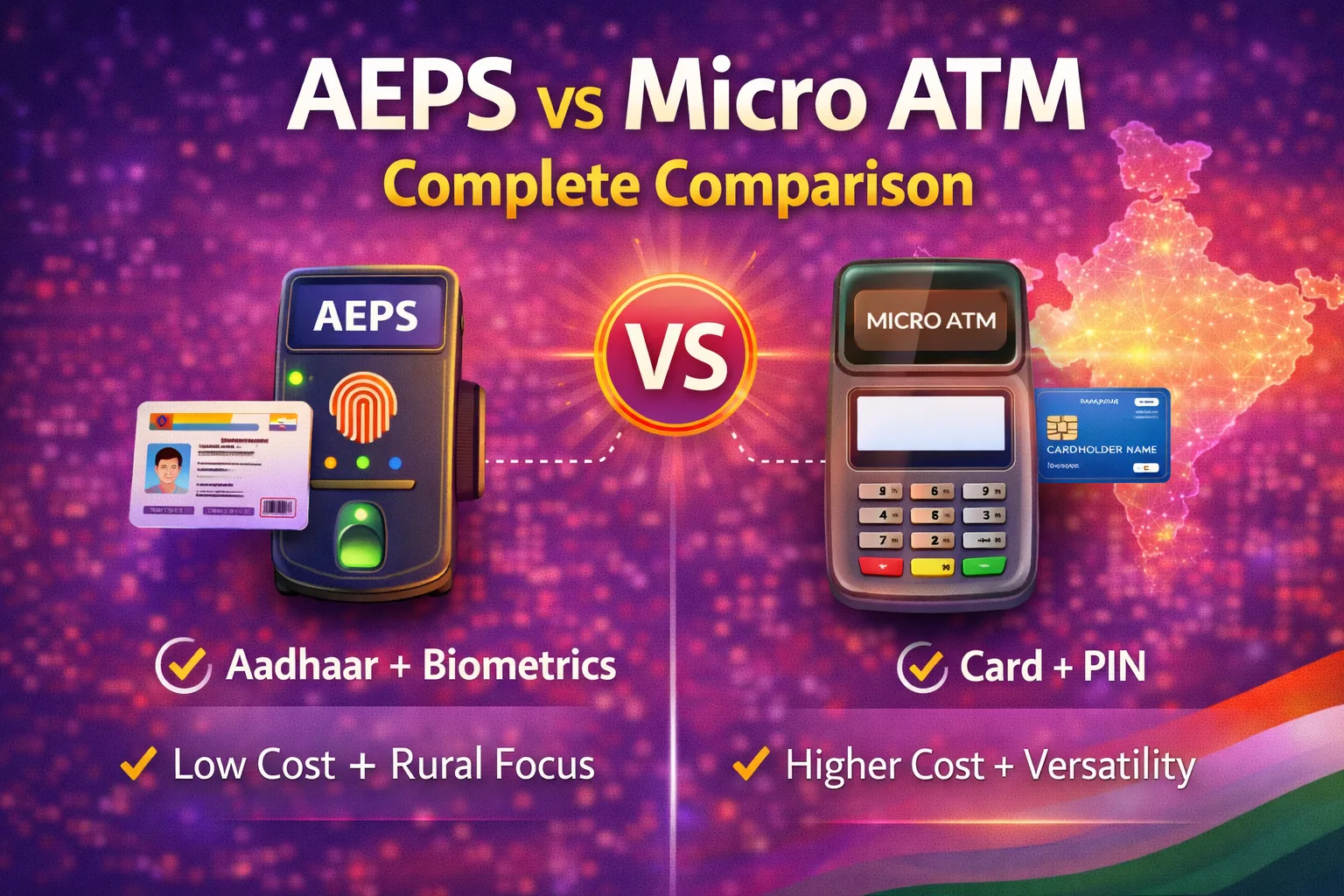
AEPS vs Micro ATM: Complete Comparison & Differences
When it comes to digital banking services, the comparison between AEPS vs Micro ATM is one of the most searched topics in India. Both solutions allow customers to access banking services like cash withdrawal and balance enquiry without visiting a bank branch.
However, choosing between AEPS vs Micro ATM depends on your business model, investment capacity, and target customers.
Start AEPS services:
https://nxtbanking.com/aeps-api-provider
AEPS vs Micro ATM Overview

What is AEPS?
AEPS (Aadhaar Enabled Payment System) is a banking system that allows transactions using Aadhaar number and biometric authentication.
It is powered by National Payments Corporation of India and widely used across India.
AEPS Services:
- Cash withdrawal
- Balance enquiry
- Mini statement
- Aadhaar Pay
Learn more:
https://www.npci.org.in/what-we-do/aeps/product-overview
What is Micro ATM?
A Micro ATM is a portable device used by banking agents to provide basic banking services using debit cards or Aadhaar authentication.
It works like a mini banking terminal and is commonly used by business correspondents.
Key Differences: AEPS vs Micro ATM
| Feature | AEPS | Micro ATM |
|---|---|---|
| Authentication | Aadhaar + Biometric | Card + PIN / Aadhaar |
| Device Required | Biometric scanner | Micro ATM machine |
| Cost | Low | Higher |
| Setup | Easy | Moderate |
| Portability | High | Medium |
| Internet Dependency | Yes | Yes |
| Transaction Speed | Fast | Fast |
| User Requirement | Aadhaar linked account | Debit card or Aadhaar |
Cost Comparison
AEPS
- Biometric device: ₹1500–₹3000
- Setup cost: Low
Micro ATM
- Device cost: ₹5000–₹15000
- Maintenance cost: Higher
Contact for setup: https://nxtbanking.com/contact
Advantages of AEPS
- Low investment
- Easy to start
- High demand in rural areas
- No debit card required
Related blog: https://nxtbanking.com/blog/aeps-business-model
Advantages of Micro ATM
- Supports card transactions
- Suitable for urban + semi-urban areas
- Higher transaction flexibility
Which is Better: AEPS vs Micro ATM?
Choose AEPS if:
- You want low investment
- Target rural customers
- Focus on Aadhaar-based transactions
Choose Micro ATM if:
- You want card-based services
- Can invest more
- Target mixed customer base
Business Perspective
From a business point of view, AEPS vs Micro ATM comparison shows:
- AEPS = Low cost + high ROI
- Micro ATM = Higher cost + broader service
Explore APIs:
https://nxtbanking.com/dmt-api
https://nxtbanking.com/bbps-api
Security & Compliance
Both AEPS and Micro ATM follow strict guidelines:
- Encrypted transactions
- Secure authentication
- Banking compliance
Learn more: https://uidai.gov.in/en/
FAQs
Is AEPS better than Micro ATM?
AEPS is better for low investment and rural markets, while Micro ATM offers more flexibility.
Can Micro ATM use Aadhaar?
Yes, many Micro ATMs support Aadhaar-based transactions.
Which is more profitable?
AEPS is generally more profitable due to lower setup cost.
Conclusion
The choice between AEPS vs Micro ATM depends on your business goals, investment, and customer base. For most small businesses and retailers, AEPS is the better starting point due to its low cost and high demand.
Start AEPS today:
https://nxtbanking.com/aeps-api-provider
About This Topic
AEPS (Aadhaar Enabled Payment System) is India's biometric banking service that gives rural and unbanked populations access to cash withdrawal, balance enquiry, and mini statement through Business Correspondent outlets. Built on UIDAI's Aadhaar authentication infrastructure and operated by NPCI, AEPS removes the dependency on bank cards and PINs. NxtBanking's AEPS API provides fintechs and BC networks with a reliable, multi-bank connected integration covering all AEPS transaction types with 99.9% uptime, real-time webhooks, and full NPCI compliance.
Quick Answers
What is AEPS and how does it work?
AEPS (Aadhaar Enabled Payment System) is an NPCI-operated banking service that authenticates customers using their Aadhaar number and biometric fingerprint, allowing cash withdrawal, balance enquiry, and mini statement at Business Correspondent points without a debit card or PIN.
Who can use AEPS?
Any Indian resident with an Aadhaar-linked bank account can use AEPS at a registered BC or Micro-ATM outlet. It is specifically designed for rural and unbanked populations who lack access to physical bank branches or ATMs.
Is NxtBanking RBI-compliant for payment APIs?
Yes. NxtBanking operates through RBI-licensed partner banks for all payment services (IMPS, NEFT, RTGS, UPI) and is NPCI-certified for BBPS, AEPS, and UPI flows. All APIs follow RBI's Master Directions on payment aggregators, KYC, and PMLA obligations. We maintain audit logs, data localisation, and consent frameworks compliant with the DPDP Act 2023.
How does NxtBanking handle API downtime and failover?
NxtBanking uses a connected-banking architecture that links a single API credential to multiple RBI-licensed partner banks. When one bank's rails experience degradation or maintenance, the API automatically routes to the next available bank — with no code change required on the client side. This multi-bank failover is what delivers 99%+ transaction success rates and 99.9% API uptime SLA for enterprise clients.
What does it cost to integrate NxtBanking APIs?
NxtBanking offers pay-as-you-go pricing with no setup fees and no minimum commitment for most APIs. Typical pricing: IMPS/UPI payout ₹3–₹8 per transaction, NEFT ₹1–₹3, BBPS bill payment ₹0.50–₹3, AEPS cash withdrawal ₹2–₹5. Enterprise clients on committed volumes negotiate flat-rate pricing. Sandbox access is free and unlimited. Contact sales for a custom quote based on your expected transaction volume.
Key Terms
- AEPS
- Aadhaar Enabled Payment System — a bank-agnostic cash withdrawal and balance enquiry service authenticated via Aadhaar biometrics, operated under NPCI.
NxtBanking is India's AI-powered fintech API platform trusted by hundreds of fintechs, BC networks, NBFCs, and enterprise companies. Our unified API marketplace covers payout (IMPS, NEFT, RTGS, UPI), BBPS bill payment with 20,000+ billers, AEPS biometric banking, KYC and identity verification (Aadhaar, PAN, Bank, Driving Licence, Voter ID, RC), UPI collection and QR codes, domestic money transfer (DMT), mobile and DTH recharge, Micro-ATM, and travel APIs — all under one master agreement, one set of credentials, and one consolidated monthly invoice.
Every NxtBanking API is backed by a 99.9% uptime SLA, real-time webhook delivery, a full-featured sandbox environment with simulated error scenarios, comprehensive API documentation with Postman collections and code samples in multiple languages, and dedicated technical onboarding support. Production go-live for most APIs is achievable within 7–15 business days after KYC and compliance review. For enterprise clients requiring custom SLAs, dedicated infrastructure, or white-label platform builds, NxtBanking offers tailored commercial terms with no minimum volume commitment at the pilot stage.


