
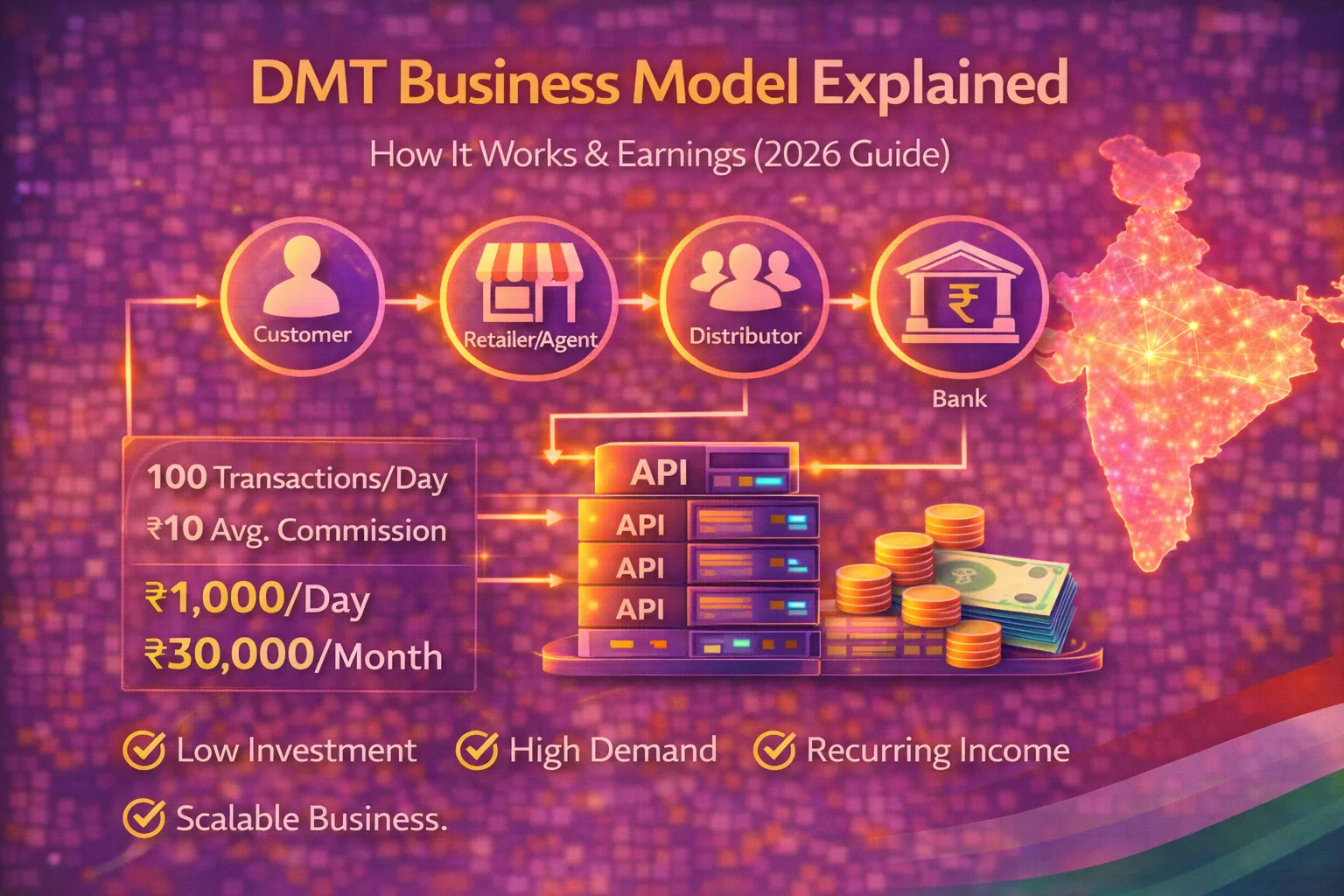
The DMT business model has become one of the most popular and profitable opportunities in the fintech industry. With increasing demand for instant money transfers, businesses can offer domestic remittance services while earning commissions on every transaction.
In India, millions of users rely on domestic money transfer services for sending funds quickly and securely. Understanding the DMT business model helps entrepreneurs, retailers, and fintech startups build scalable and recurring revenue streams.
Inbound Link:
API Marketplace
What is the DMT Business Model
The DMT (Domestic Money Transfer) business model allows businesses to facilitate bank-to-bank money transfers using API-based platforms.
Instead of directly connecting with banks, businesses integrate with a DMT API provider, which connects them to banking networks.
This model enables:
- Instant money transfers
- Multi-bank connectivity
- Secure transactions
- Real-time status updates
How the DMT Business Model Works
Step-by-Step Flow
- Customer visits retailer or uses app
- Sender registration is completed
- Beneficiary bank account is added
- Transfer amount is entered
- DMT API processes the request
- Money is transferred via IMPS/NEFT/RTGS
- Confirmation is generated
These systems are supported by National Payments Corporation of India and banking networks.
Outbound Links:
NPCI
Reserve Bank of India
Key Participants in DMT Business Model
Customer
The end user who wants to send money.
Retailer / Agent
Provides money transfer services to customers and earns commission.
Distributor
Manages multiple retailers and earns a share of their transactions.
API Provider
Provides infrastructure and connectivity to banking systems.
Banking Network
Processes actual fund transfers (IMPS, NEFT, RTGS).
Types of DMT Business Models
Retailer-Based Model
Local shops or agents offer money transfer services to customers.
Distributor Model
Distributors onboard and manage retailers, earning commission from their transactions.
API / Fintech Model
Businesses build apps or platforms and integrate DMT APIs.
White-Label Model
Businesses launch their own branded money transfer platform using API services.
Revenue Model in DMT Business
Transaction Commission
Earn commission on each successful transaction.
Customer Service Fee
Charge customers a small convenience fee.
Distributor Margin
Earn a percentage from retailer transactions.
Cross-Selling Services
Increase revenue by offering:
- AEPS
- BBPS
- Recharge
Inbound Links:
API Marketplace
API Marketplace
Example of DMT Earnings
Scenario
- 100 transactions per day
- Average commission: ₹10 per transaction
Earnings
- Daily: ₹1,000
- Monthly: ₹30,000
This shows how the DMT business model generates consistent income.
Advantages of DMT Business Model
Low Investment
Requires minimal setup cost.
High Demand
Money transfer services are used daily.
Recurring Income
Earn commission on every transaction.
Scalable Business
Easily expand with more services and users.
Easy Integration
API-based model simplifies setup and operations.
Challenges in DMT Business Model
Low Margin Per Transaction
Requires high volume to generate significant income.
Competition
Many players are entering the fintech space.
Compliance Requirements
KYC and regulatory requirements must be followed.
Technical Dependency
Reliance on API provider uptime and performance.
How to Start a DMT Business
Step 1
Choose a business model (retailer, distributor, or fintech platform)
Step 2
Select a reliable DMT API provider
Inbound Link:
Contact us
Step 3
Complete KYC and onboarding
Step 4
Set up platform or retail outlet
Step 5
Start offering money transfer services
Future of DMT Business Model
The future of the DMT business model is strong due to:
- Growth in digital payments
- Increased fintech adoption
- Expansion in rural markets
- API-based financial services
Businesses adopting DMT early can gain a competitive advantage.
FAQs
What is DMT business model
It is a system where businesses offer money transfer services and earn commission on transactions.
Is DMT business profitable
Yes, it provides recurring income with high transaction volume.
Who can start DMT business
Retailers, fintech startups, and service providers.
How does DMT business earn money
Through commission, service fees, and transaction volume.
Conclusion
The DMT business model is one of the most effective fintech opportunities in India. It combines low investment, high demand, and scalable earnings.
By choosing the right API provider and focusing on customer service, businesses can build a profitable and sustainable money transfer business.
Inbound Link:
API Marketplace