
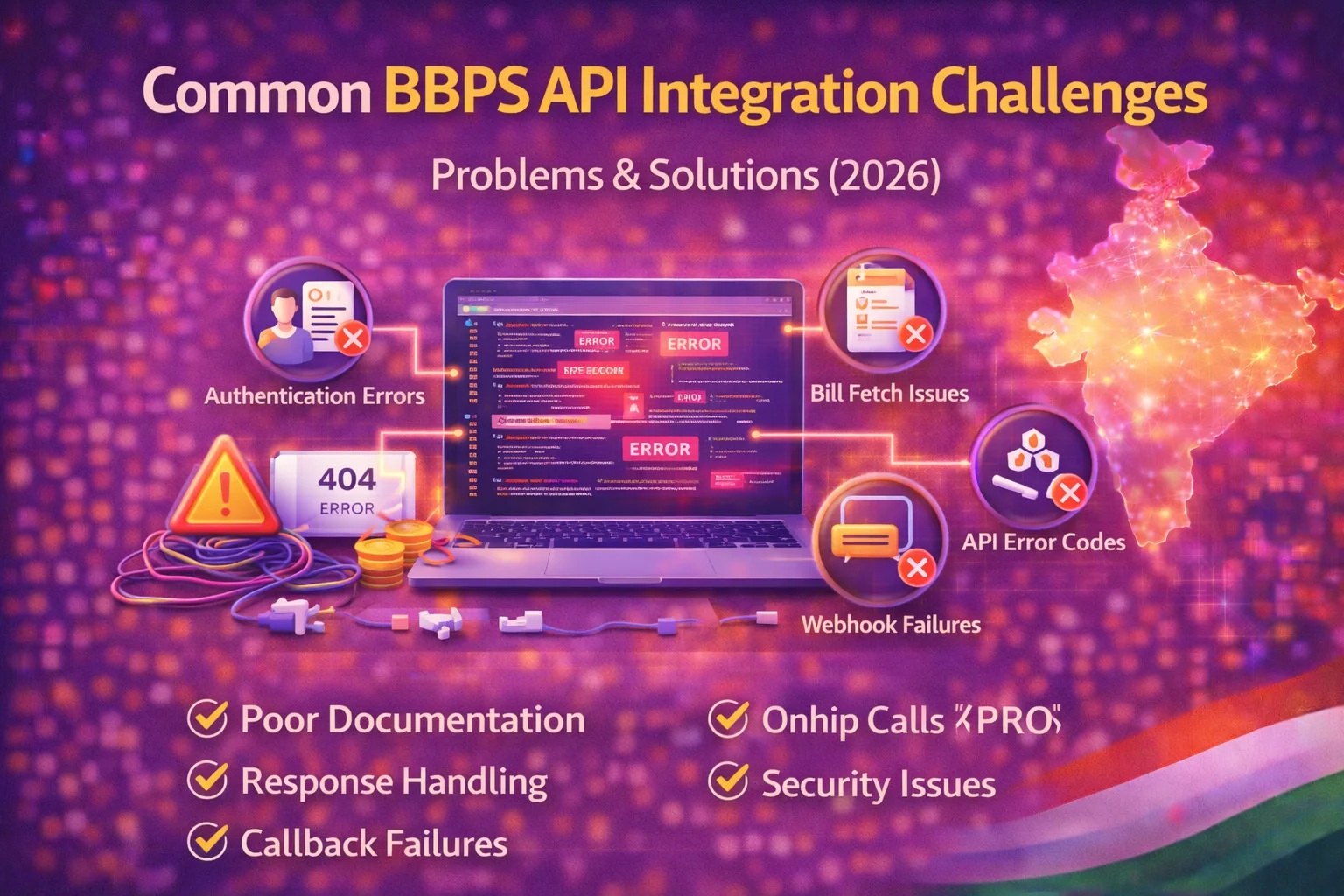
Understanding common BBPS API integration challenges is important for any business planning to launch bill payment services. While BBPS API offers a powerful and scalable way to provide digital bill payments, integration is not always straightforward.
Fintech companies, retailers, and payment platforms often face technical, operational, and compliance-related issues during implementation. Identifying these common BBPS API integration challenges early helps reduce delays, improve transaction success rate, and ensure a smoother launch.
Internal Link:
API Marketplace
What is BBPS API Integration
BBPS API integration is the process of connecting your website, app, or payment platform with a Bharat Bill Payment System provider so you can offer bill payment services such as:
- Electricity bill payments
- Mobile recharge
- DTH recharge
- Gas bill payments
- Water bill payments
- Insurance premium payments
A successful integration requires proper API configuration, secure request handling, testing, and provider coordination.
Why Businesses Face BBPS API Integration Challenges
Many businesses assume BBPS integration is only about plugging in an API. In reality, it involves multiple layers such as:
- Authentication
- Biller mapping
- Request and response handling
- Transaction status tracking
- Settlement logic
- Error management
- Compliance requirements
Because of these moving parts, common BBPS API integration challenges can affect both launch speed and service quality.
Common BBPS API Integration Challenges
Incomplete or Confusing API Documentation
One of the most frequent problems is unclear API documentation. If the documentation does not properly explain endpoints, request structure, response parameters, and error codes, developers can make implementation mistakes.
Solution
- Choose a provider with detailed documentation
- Ask for sample requests and responses
- Test each endpoint separately before full integration
Authentication and Credential Errors
BBPS APIs usually require secure authentication using API keys, client IDs, secret keys, tokens, or IP whitelisting. Incorrect configuration can lead to authentication failure.
Solution
- Verify all credentials carefully
- Keep test and live credentials separate
- Store credentials securely on the server side
Biller Fetch and Validation Issues
Many businesses face issues while fetching bill details from the API. Incorrect consumer number format, missing parameters, or biller-specific validation rules often cause failed bill fetch responses.
Solution
- Validate user input before sending request
- Handle biller-specific fields carefully
- Add clear error messages for invalid bill details
Request and Response Handling Problems
Improper parsing of API responses can create major issues. If your system fails to read success status, pending responses, or bill amount data correctly, the customer journey breaks.
Solution
- Build robust response-handling logic
- Map all response codes properly
- Test success, failure, and pending cases separately
Transaction Status Mismatch
A common BBPS API integration challenge is mismatch between payment attempt and transaction status. Sometimes payment may be initiated, but confirmation is delayed or marked pending.
Solution
- Use transaction status API regularly
- Maintain unique transaction IDs
- Build retry-safe architecture to avoid duplicate payments
Callback and Webhook Failures
Many BBPS systems use callbacks or webhooks for final transaction updates. If the callback URL is not configured correctly, or the server is unavailable, payment status may not sync properly.
Solution
- Test webhook endpoints thoroughly
- Use secure and stable callback URLs
- Log all callback responses for debugging
Sandbox and Live Environment Differences
Another major issue is that the sandbox environment may behave differently from the production environment. A flow that works in testing may fail after go-live due to different validations or biller availability.
Solution
- Ask the provider about live environment differences
- Perform limited live testing after launch
- Prepare support team for initial transaction monitoring
Internal Link:
API Marketplace
Poor Error Code Management
If your system does not properly interpret API error codes, customers may only see generic failure messages. This creates confusion and increases support requests.
Solution
- Maintain a complete error code library
- Show user-friendly messages on frontend
- Keep technical logs for backend troubleshooting
Compliance and Onboarding Delays
BBPS integration may involve documentation, KYC checks, business verification, and provider approval. These steps can delay launch if not handled early.
Solution
- Complete compliance requirements in advance
- Keep registration documents ready
- Follow up regularly with provider onboarding team
Settlement and Reconciliation Challenges
After integration, businesses may struggle with payment settlement visibility and reconciliation between successful transactions and received funds.
Solution
- Use dashboard reports daily
- Match transaction logs with settlement data
- Build internal reconciliation process
UI and Customer Experience Issues
Even if the backend API works well, poor frontend design can create friction. Long forms, unclear biller selection, and confusing payment flows reduce conversion.
Solution
- Keep the payment flow simple
- Use clean biller categorization
- Show clear success, pending, and failed states
Network and Server Dependency
BBPS API performance depends on internet stability, provider server uptime, and biller response speed. Network issues can cause timeout or delayed responses.
Solution
- Use retry logic carefully
- Set proper timeout rules
- Work with a provider that offers high uptime and support
Technical Best Practices to Avoid BBPS API Integration Challenges
Use a Modular Architecture
Keep bill fetch, payment, status check, callback, and reconciliation modules separate. This makes debugging easier.
Log Everything
Maintain logs for requests, responses, callbacks, and status updates. Logs are essential for issue resolution.
Handle Pending Transactions Properly
Not every payment gets immediate confirmation. Your system should support pending states and later updates.
Secure the API Layer
Use HTTPS, token validation, server-side authentication, and access controls to protect sensitive transaction data.
Test Edge Cases
Test invalid bill numbers, network failures, timeout scenarios, duplicate requests, and wrong credentials.
Business Impact of Integration Challenges
If common BBPS API integration challenges are not handled properly, businesses may face:
- Failed transactions
- Customer dissatisfaction
- Increased refund or support workload
- Delayed launch
- Revenue loss
- Reduced trust in platform
That is why choosing the right provider and preparing a solid technical workflow is essential.
How to Choose the Right Provider to Reduce Integration Problems
A good BBPS API provider can reduce most technical and operational issues. Before selecting a provider, check:
- API documentation quality
- Sandbox support
- Error code clarity
- Support response time
- Transaction success rate
- Dashboard and reconciliation tools
- Live onboarding assistance
A reliable provider makes a major difference in handling common BBPS API integration challenges.
FAQs
What are the most common BBPS API integration challenges
The most common issues include authentication errors, bill fetch problems, callback failures, response handling issues, and settlement mismatches.
Why does BBPS bill fetch fail
Bill fetch may fail because of invalid consumer details, missing parameters, or biller-specific validation rules.
How can I reduce BBPS integration issues
You can reduce issues by choosing a reliable provider, testing thoroughly, validating inputs, and handling transaction statuses correctly.
Is sandbox testing enough for BBPS integration
Sandbox testing is necessary, but you should also prepare for live environment differences and monitor transactions after go-live.
Conclusion
Understanding common BBPS API integration challenges helps businesses launch faster and operate more smoothly. Most problems happen because of poor documentation, weak testing, incorrect request handling, or provider-side communication gaps.
With the right provider, proper development practices, and careful testing, businesses can overcome these challenges and build a secure, scalable, and reliable BBPS bill payment platform.